Main Article: Avian Medical Terms / Health & Diseases by Jeannine Miesle, MA, Allied Member, Association of Avian Veterinarians …
Avian Anatomy Image Gallery (NOTE: Some of the images / illustrations on this and linked pages may be too graphic for young audiences. We recommend parental supervision and approval.)
- Skeletal System … Feathers & Skin (scroll down) … Cloaca and Bursa of Fabricus … Muscles and Tendons, Feather Piloerection
- Bird Head & Beak … Bird Eye / Ear Anatomy / Sensory Perception … Bird Brain & Nervous System
- Respiratory System … Bird Reproductive Organs … Bird Digestive System … Circulatory System – Blood & Heart … Glands … Liver & Kidneys / Surgical Instruments
- Cells, Genetics & DNA … Wound Healing
FEATHERS AND SKIN
http://www.bing.com/images/search?q=feather+tracts+in+birds&view=detailv2&&&id=938C721BF3E8CF3AD68F3F78F47 AFA657C5D3EC8&selectedIndex=0&ccid=1%2fSY7eP%2b&simid=608039426881686875&thid=JN.NwoXUpGclwD6iVP 1LMt77g&ajaxhist=0
FREE Training to Stop Your Bird's Biting
Get FREE access to Beak School – the only system designed to train your bird. Stop behavioral problems like biting, screaming, feather plucking.
Get the Free Training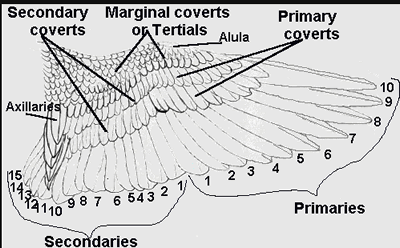 Primary and secondary feathering, feather numbering of wing
Bird feathers http://www.earthlife.net/birds/images/anatomy/wing.gif
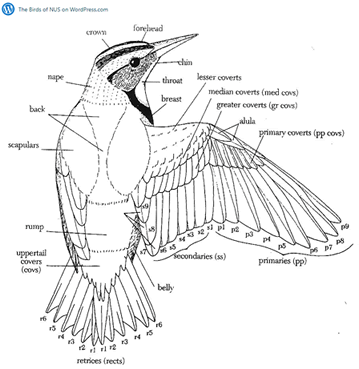
Numbering of Wing and Tail feathers https://nusavifauna.files.wordpress.com/2012/08/bird_anatomy_1.jpeg
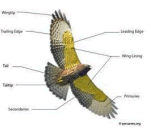 Leading edge of wing http://www.bing.com/images/search?q=leading+edge+of+bird+wing&view=detailv2&&&id=A04C6A6D17F24925EF2456B 211673B6D55097953&selectedIndex=149&ccid=DvCZsmAL&simid=608021164690639938&thid=JN.fwDqwXUM5Yjwv% 2f1tqk5kpg&ajaxhist=0
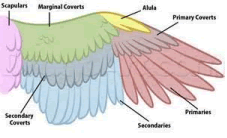
Inner wing feathers http://www.bing.com/images/search?q=inner+wing+of+bird&view=detailv2&&&id=0FD8F69BAAB720282CD2A720FABA5 67 9CBF4A077C0&selectedIndex=13&ccid=FmkYx6xG&simid=608005019906083412&thid=JN.jBWBLxcPRox7QiumBHI0V g&ajaxhist=0
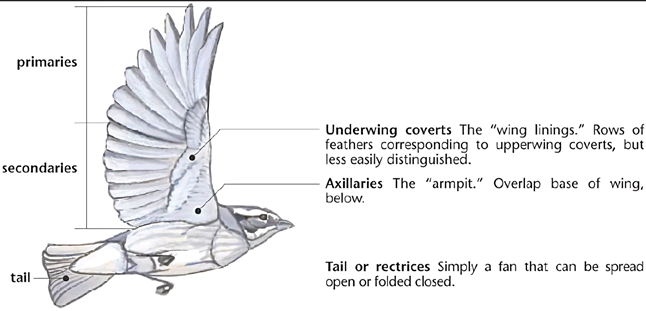
Wing feathers http://www.bing.com/images/search?q=bird+wing+feathers&view=detailv2&&&id=56E04B780B39624579A0450C417056 A2ECD277D6&selectedIndex=1&ccid=bFNrLqrW&simid=608027461098997025&thid=JN.ElzuSQDr7G%2faSRg6vDksH A&ajaxhist=0
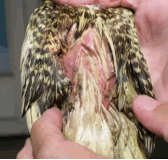
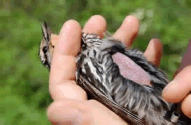
Brood patch http://www.bing.com/images/search?q=brood+patch&view=detailv2&&&id=9216B471633D5A8D9BA7D618C4 24B4E1A4BFFB07&selectedIndex=13&ccid=un7L9bao&simid=608015834619776290&thid=JN.6rL5KMAnJgI3 CDrFvr%2b6QQ&ajaxhist=0
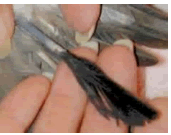
Blood Feathers and feather sheaths. Blood feather and feather sheath http://www.bing.com/images/search?q=blood+feather&view=detailv2&&qpvt=blood+feather&id=A6D4730BD3C2500F8C9 C989B50D6E7D27C37FF5F&selectedIndex=5&ccid=C48qBHE/&simid=608044821348289044&thid=JN.u1jHpa
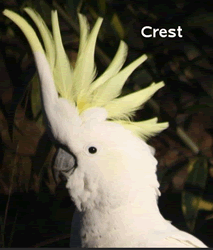
Recursive Crest http://www.bing.com/images/search?q=bird+crest&view=detailv2&&&id=F727ED95B26BB7654CF57DF76D1E 68 DCC98091F1BD&selectedIndex=163&ccid=Vl1q/Gf+&simid=608031330837335601&thid=HN.6080313308373 3
 Recumbent Crest http://www.bing.com/images/search?q=bird+glottis&view=detailv2&&&id=19F36453DEA8572015FDD0ED95C 7EAEC41AE09CD&selectedIndex=0&ccid=ogpWS2Ug&simid=608004298336109970&thid=JN.DAtJUsry08c% 2fjgBQEtA7%2fw&ajaxhist=0
Feather anatomy from Drs. Foster and Smith
http://www.peteducation.com/article.cfm?c=15+1829&aid=2776
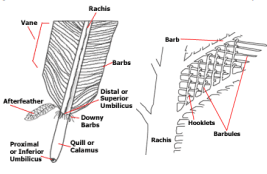
Parts of the feather:
- Calamus: Central shaft at the base which extends under the skin into the feather follicle.
- Rachis (scapus or quill) feather shaft above the calamus that holds the barbs.
- Vane: part of the feather that holds the barbs
- Barbs: filaments on either side of rachis, extend at approximately 45 degree angle from rachis
- Barbules and barbettes (hooklets): microscopic filaments that attach to each other, forming a tight, smooth surface. Bird keeps them attached during preening.
- After-feathers (hypopenae): small tuft of feather at the base of the rachis.
- Downy Barbs: barbs that are not hooked together at base of rachis.
- Pennaceous feathers: those with barbules and hooklets, as in quill pen.
- Plumaceous: down feathers, without rachis and quill
- Distal Umbilicus: the base of the vane
- Proximal or inferior umbilicus: the end of the calamus that is attached to the follicle
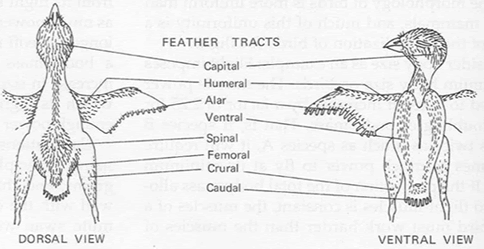
- Pterylae: feather tracts
- Apteria: featherless areas between the pterylae
 Types of feathers: each type has a different function
Contour feathers:
- Cover most of the surface of the bird, providing a smooth appearance. 69 Protect the bird from sun, wind, rain, and injury.
- Brightly colored and have different color patterns.
- Divided into flight feathers and those that cover the body.
Flight feathers: Wing and tail feathers
FREE Training to Stop Your Bird's Biting
Get FREE access to Beak School – the only system designed to train your bird. Stop behavioral problems like biting, screaming, feather plucking.
Get the Free TrainingRemiges: flight feathers of the wing, separated into three groups:
- Primaries: long feathers attached to the manus (metacarpal [wrist] and phalangeal [finger] bones) at the far end of the wing Responsible for forward thrust. There are usually 10 primaries, numbered from the inside out.
- Secondaries: attached to the ulna, a bone in the middle of the wing, Supply “lift” and are used in courtship displays. There are usually 10-14 secondaries, numbered from the outside in.
- Tertiaries: flight feathers closest to the body; attached to the humorus (long bone)
Retrices: tail feathers; act as brakes and a rudder, Control the orientation of the flight. Most birds have 12 tail feathers, numbered from the center out
Coverts: Smaller feathers that cover the bases of the flight feathers There are several layers of contour coverts on the wing and ear.
 Down feathers
- Small, soft, fluffy, and are found under the contour feathers.
- Plumaceous, and have many non-interlocking barbs,
- Lacking the barbules and hooklets seen in contour and flight feathers.
- This makes it possible for them to trap air in an insulating layer next to the skin, protecting the bird from heat and cold. Powder down feathers: give off powder
- When the sheaths or barbs of these feathers disintegrate, they form a fine keratin powder, which the bird can spread over its feathers as a water-proofing agent.
- The powder assists in cleaning as the bird preens.
- The absence of powder down in birds such as cockatoos and African greys can be a sign of disease, including Psittacine Beak and Feather Disease.
Filoplumes
- Fine, hair-like feathers with a long shaft, and only a few barbs at their tips.
- Located along all the pyterlae.
- Although their function is not well understood, they are thought to have a sensory function, possibly adjusting the position of the flight feathers in response to air pressure.
 Semiplumes:
- Provide form, aerodynamics, and insulation.
- Play a role in courtship displays.
- Have a large rachis, but loose (plumaceous) vanes.
- They may occur along with contour feathers or in separate pterylae.
Bristle feathers:
- Have a stiff rachis with only a few barbs at the base.
- Usually found on the head (around the eyelids, nares, and mouth).
- Have both a sensory and protective function.
Feather growth
Follicles: specialized areas in the skin where feathers develop.
FREE Training to Stop Your Bird's Biting
Get FREE access to Beak School – the only system designed to train your bird. Stop behavioral problems like biting, screaming, feather plucking.
Get the Free TrainingBlood feather:
- A developing feather that has an artery and vein that extend up through the shaft and nourish the feather.
- Has a larger quill (calamus) than a mature feather Is covered with a waxy keratin sheath that protects it while it grows
- The sheath is removed by the bird when the feather is mature, after the blood supply recedes
Shaft color:
- Will be purple while blood is still nourishing the feather.
- Will change to white when blood recedes back into the body after the feather has grown out.
Molt:
- A bird will molt out or lose all of its feathers about once a year.
- It takes months to lose and replace feathers, allowing the bird to continue to fly
- The adult bird will gradually replace all of its feathers during a molt This is so the bird can continue to fly and maintain body temperature
- A molt usually takes place after breeding season.
- reeding season is triggered by the longer photoperiod in the spring, so molting occurs during the summer; wild birds develop brighter plumage
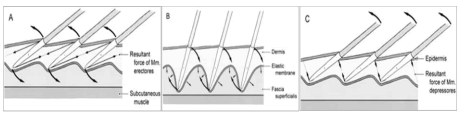
Erector and depressor muscles in skin http://pubs.sciepub.com/materials/1/2/2/figs
FREE Training to Stop Your Bird's Biting
Get FREE access to Beak School – the only system designed to train your bird. Stop behavioral problems like biting, screaming, feather plucking.
Get the Free TrainingFeather duster disease http://www.bing.com/images/search?q=feather+duster+disease&view=detailv2&&&id=3DFA1B549B49DFCC6FE3C08012 5DB9BA26BDA726&selectedIndex=0&ccid=CvNnRnV%2b&simid=608033869188628558&thid=JN.Xbn6YFGaXLHaxsTG F9CRNg&ajaxhist=0

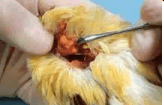
Feather Cyst http://www.bing.com/images/search?q=bird+glottis&view=detailv2&&&id=19F36453DE A8572015FDD0ED95C7EAEC41AE09CD&selectedIndex=0&ccid=ogpWS2Ug&simid=608004298336109970& thid=JN.DAtJUsry08c%2fjgBQEtA7%2fw&ajaxhist=0
SKIN
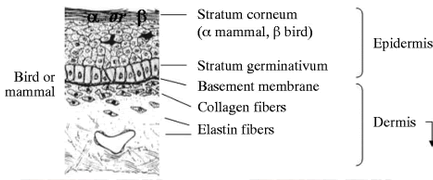
Cross section of a bird’s skin http://people.eku.edu/ritchisong/avian_integument.htm
Dermatitis (Miesle)