
If you want to know about the Eclectus Parrots and their Sub-species Identification, visit Beauty of birds and get all the related information in one place.
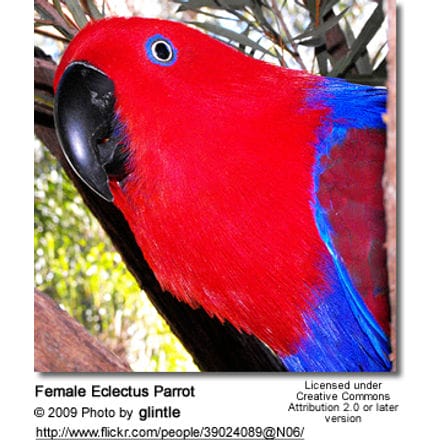
Eclectus Information (Personality, Care, Diet, Subspecies)
FREE Training to Stop Your Bird's Biting
Get FREE access to Beak School – the only system designed to train your bird. Stop behavioral problems like biting, screaming, feather plucking.
Get the Free TrainingThe following information and photos (unless stated otherwise) are copyrighted and have been reproduced with the permission of the owner of the material: Dr. Rob Marshall – an avian vet and bird breeder in Australia, and author of “A Guide to Eclectus Parrots as Pet and Aviary Birds“.
In Australia, the most frequently kept Eclectus parrot subspecies are hybrids of the
- New Guinea Red-sided Eclectus (Eclectus roratus polychlorus)
- the Solomon Island Eclectus (Eclectus roratus solomonensis).
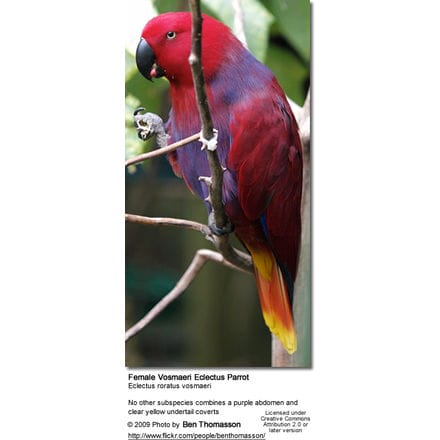
In America, the most commonly kept sub-species are the:
- Solomon Island Eclectus (Eclectus roratus solomonensis)
- Grand Eclectus (Eclectus roratus roratus)
- Vosmaer’s Eclectus(Eclectus roratus vosmaeri) and
- Red Sided Eclectus (Eclectus roratus polychloros)
In Europe, the most commonly kept sub-species are:
Identification of the subspecies is challenging in the female and almost impossible in the male without knowledge of the area of origin or domestic breeding history.
Female Identification
Females of the different subspecies may be distinguished from each other by differences in size and color. It is Dr Rob Marshall’s view that identification of Eclectus hens is made easier when the subspecies are divided into three groups:
- Blue (polychlorus)
- Purple (roratus) and
- Red (cornelia / riedeli)
Hen classification of some of the subspecies remains difficult without knowledge of their geographic origins.
| Purple Group Grand Eclectus E.r. roratus Vosmaeri Eclectus E.r. vosmaeri Red Group Reideli’s Eclectus E.r. riedeli Cornelia’s Eclectus E.r. cornelia | Blue Group Red-sided Eclectus E.r. polychlores Solomon Island Eclectus E.r. solomonensis Australian Eclectus E.r. macgillivrayi Aruensis Eclectus E.r. aruensis Biaki Eclectus E.r. biaki |
BLUE (POLYCHLORUS) GROUP
Females of the Blue (polychlorus) group have a blue eye ring, blue breast colour and lack yellow in their plumage.
There are five subspecies in the Blue (polychlorus) group:
- Solomon Island Eclectus Parrot (Eclectus roratus solomonensis)
- New Guinea Red-sided Eclectus Parrot (Eclectus roratus polychloros)
- Australian Eclectus Parrot – also known as Queensland Eclectus Parrot (Eclectus roratus macgillivrayi)
- Aru Island Eclectus Parrot (Eclectus roratus aruensis)
- Biak Island Eclectus Parrot ( Eclectus roratus biaki)
Some consider Aru Island Eclectus (E.r.aruensis) and Biak Island Eclectus (E.r. biaki) to be variations of the New Guinea Eclectus (E.r. polychlorus).

PURPLE (RORATUS) GROUP
There are two subspecies in the Purple (roratus) group:
- Grand Eclectus (E.r. roratus)
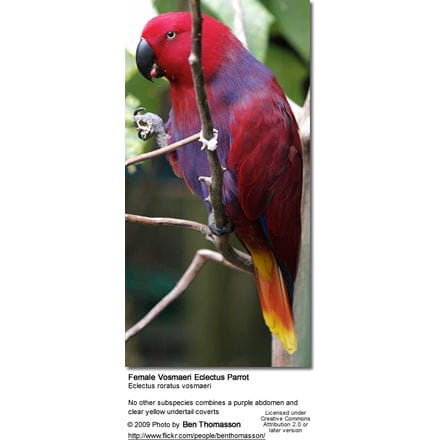
- Vosmaer’s Eclectus (E.r. vosmaeri).
These subspecies have no blue eye ring. The different colour purple of the chest feathers readily distinguishes one from the other. E.r. roratus has a purple colored breast and dark maroon colored wings. E.r. vosmaeri is brighter colored than E.r. roratus. The breast is pretty lavender (pale purple) and wings are a fire engine red colour.
RED (CORNELIA / RIEDELI) GROUP
There are two subspecies in the Red group:
- Tanimbar Island (Reideli) Eclectus (E. r. riedeli)
- Sumba Island (Cornelia) Eclectus (E.r. cornelia)
Both these subspecies are entirely red. E.r. cornelia is larger but has no yellow on the tail contrary to E. r. riedeli.
Size Differences Amongst Eclectus Species
| Sub-species – starting with the largest species | in cm | in inches |
| Macgillivray or Australian Eclectus, Eclectus roratus macgillivrayi | 37 cm | 14.5 in |
| Cornelia’s Eclectus, Eclectus roratus cornelia | 35.50 cm | 14 in |
| Vosmaeri Eclectus, Eclectus roratus vosmaeri | 34 – 35 cm | 13.4 – 13.8 in |
| Aru Island Eclectus Parrot or Aruensis Eclectus, Eclectus roratus aruensis | 34 – 35 cm | 13.4 – 13.8 in |
| Red-sided Eclectus, Eclectus roratus polychloros | 33 – 34 cm | 13 – 13.4 in |
| Solomon Island Eclectus, Eclectus roratus solomonensis | 30.5 – 33 cm | 12 – 13 in |
| Biaki Eclectus, Eclectus roratus biaki | 31.75 cm | 12.5 |
| Grand Eclectus, Eclectus roratus roratus | 30.5 cm | 12 in |
| Westermani Eclectus, Eclectus roratus westermani (validity of this sub-species disputed) | 29.25 cm | 11.5 in |
| Riedeli’s Eclectus, Eclectus roratus riedeli | 29.25 cm | 11.5 in |
Eclectus Roratus Female Identification
| Grand | Red-Sided | Solomon Island | Vosmaeri | |
| Size | 12 inches / 30.5 cm | 13 inches / 33 – 34 cm | 12 – 13 inches / 30.5 – 33 cm | 13 inches / 34 – 35 cm |
| Weight (Younger birds generally weigh less than birds that are over 2 years old) | Female: 375 g (Male: 415 g – 433 g) | Females: 380 g – 427g (Male: 376g – 526g) | Female: 390 g – 430g (Male: 350g – 400g) | Female: 366 g -460 g (Male: 398g – 455g) |
| Blue Eye Ring | Absent | Present | Present | Absent |
| Breast Color | Light Purple | Royal Blue | Royal Blue | Light Purple |
| Tail / Tail Tip | Bright red with (yellow-end orange tip | Red | Red | Broad yellow tip |
| Vent | Red | Red | Red | Yellow (can have some touches of red) |
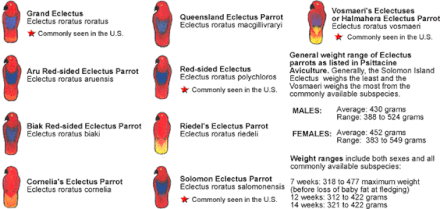
Vosmaeri, and Solomon Island Eclectuses (Shades of Red and Green Eclectus Website)

Male Identification
Identification of the males from most subspecies remains difficult and relies upon differences in size and shade of green of the plumage. Both size and depth of green however may vary considerably within the same subspecies.
Male Eclectus are difficult to distinguish into species with the exception of macgillivrayi, riedeli and westermani.
- Macgillivrayi is large and long with a distinctive broad square head.
- Riedeli and Westermani are smaller and have distinct features.
Variation between individuals of the same sub-species also creates complication in identification.
Further classification difficulties arise because interbreeding of subspecies has been common in the past. As a result, confusion often arises when attempting to identify the exact sub-species of captive bred Eclectus Parrots.
More Eclectus Information
- Eclectus Information (Personality, Care, Diet)
- Eclectus Species
- Eclectus Sub-species Identification
- Talking Ability (compared to other species)
- Common Diseases / Conditions of the Eclectus Parrot
- Eclectus Foods
- Purchasing an Eclectus Parrot
- Cages / Flights – Recommendations / Set Up Ideas
Eclectus Species
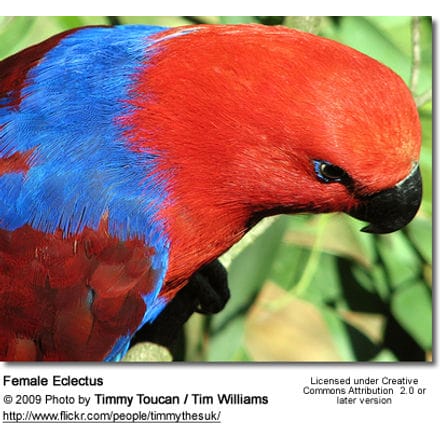
The genus Eclectus is composed of nine (possibly ten) subspecies, with differences in size, coloring, and natural range. Want to know more visit Beauty of Birds and access all the information.
The genus Eclectus is composed of nine (possibly ten) subspecies, with differences in size, coloring and natural range.
Of these subspecies, the following four are the most commonly seen in captivity:
- Red-sided Eclectus (Eclectus roratus polychloros)
- Native Range: New Guinea mainland
- ID: blue eye rings, no yellow tail tips
- Grand Eclectus (Eclectus roratus roratus)
- Native Range: Southern Moluccan Islands also known as Maluku Islands, Moluccas or the Spice Islands
- Solomon Island Eclectus (Eclectus roratus solomonensis)
- Native Range: Solomon Islands (east of New Guinea)
- Vosmaeri Eclectus or Vos Eclectus (Eclectus roratus vosmaeri)
- Native Range: Northern Moluccan Islands
- ID: No blue eye rings. Yellow tail tips.

Significantly less common and unknown in the United States are the:
- Biaki or Biak Island Eclectus (Eclectus roratis biaki)
- Native Range: Biak Islands – northwest of New Guinea
- Sumba Island Eclectus aka Cornelia’s Eclectus (Eclectus roratus cornelia)
- Natige Range: Sumba Islands in Indonesia
- Australian Eclectus Parrot or Macgillivray Eclectus (Eclectus roratus macgillivrayi)
- Native Range: Australia, specifically the Cape York Penninsula
- At an average length of 37 cm or 14.5 inches, this is the largest of all Eclectus species
- Tanimbar Islands Eclectus or Riedeli’s Eclectus (Eclectus roratus riedeli)
- New Guinea Red-sided Eclectus Parrot (Eclectus roratus polychloros)
- Native Range: New Guinea
- Aru Island Eclectus Parrot (Eclectus roratus aruensis
- Native Range: Aru Islands (southwest of New Guinea)
- Larger than the Red-sided Eclectus. The male has red eyes.
- Westerman’s Eclectus Parrot (Eclectus roratus westermani) – doubtfully valid.
- ID: At an average length of 29.25 cm or 11.5 inches, this is (together with the Riedeli’s Eclectus) the smallest of all Eclectus species.

Eclectus Roratus Female Identification
FREE Training to Stop Your Bird's Biting
Get FREE access to Beak School – the only system designed to train your bird. Stop behavioral problems like biting, screaming, feather plucking.
Get the Free TrainingSub-Species:
Ceram Eclectus Parrot (Eclectus r. roratus) – Grand Eclectus
Species: Scientific: Eclectus roratus cornelia aka Lorius roratus cornelia … English: Cornelia’s Eclectus Parrot … Dutch: Cornelia’s Edelpapegaai … German: Cornelia Edelpapagei … French: Perroquet eclectus de Cornelia
Distribution: Sumba in the Lesser Sunda Islands

Halmahera Eclectus (Vosmaeri Eclectus)
Queensland Eclectus Parrots or Macgillivray Eclectus
Oceanic Eclectus Parrot (Eclectus infectus) is an extinct parrot species which occurred on Tonga and Vanuatu (possibly on Fiji)
FREE Training to Stop Your Bird's Biting
Get FREE access to Beak School – the only system designed to train your bird. Stop behavioral problems like biting, screaming, feather plucking.
Get the Free TrainingRed-sided Eclectus aka New Guinea Eclectus
Species: Scientific: Eclectus roratus riedeli … English: Riedel’s Eclectus Parrot … Dutch: Riedels Edelpapegaai … German: Riedels Edelpapagei … French: Perroquet eclectus de Riedel
Distribution: Tinimbar Islands
FREE Training to Stop Your Bird's Biting
Get FREE access to Beak School – the only system designed to train your bird. Stop behavioral problems like biting, screaming, feather plucking.
Get the Free TrainingSolomon Island Eclectus aka Solomon Eclectus
Vosmaeri’s Eclectus aka Halmahera Eclectus Parrot
Westerman’s Eclectus Parrots: It is unknown if this is a real subspecies or an aviary bred bird.
Description: The Westerman’s Eclectus hen has a dark smoky abdomen and is smaller than the females of the other sub-species, which feature blue or purple abdomens. Identification of the males in the various subspecies is much more difficult to determine. The usual method being differences in the size of the bird and the shade of green in their plumage.
Species: Scientific: Eclectus roratus westermani … English: Westerman’s Eclectus Parrot … Dutch: Westermans Edelpapegaai … German: Westermans Edelpapagei … French: Perroquet eclectus de Westerman
Distribution: only known by aviary specimens
Taxonomy and Recommended Websites:
Class:Aves
Order:Psittaciformes
Family:Psittacidae … Subfamily: Psittacinae
Genus: Scientific: Eclectus … English: Eclectus Parrots … Dutch: Edelpapegaaien … German: Edelpapageien … French: Perroquet eclectus … CITES II: Endangered Species
More Eclectus Information
- Eclectus Information (Personality, Care, Diet)
- Eclectus Species
- Eclectus Sub-species Identification
- Talking Ability (compared to other species)
- Common Diseases / Conditions of the Eclectus Parrot
- Eclectus Foods
- Purchasing an Eclectus Parrot
- Cages / Flights – Recommendations / Set Up Ideas
