
Species of Ringneck Parrots and Parakeets with Links to Species Pages about each individual species.
Australian Ringneck Parrots … Ringneck Photo Gallery

Ringneck Parrot Information Page (pet potential, breeding, feeding, health, etc.)
FREE Training to Stop Your Bird's Biting
Get FREE access to Beak School – the only system designed to train your bird. Stop behavioral problems like biting, screaming, feather plucking.
Get the Free TrainingMost Common Species:
- Alexandrine Parakeets
- Indian Ringnecks
- Moustached / Mustached / Java Parakeets
- Plum-headed Parakeets aka Plumheads
- Rose-ringed Parakeets
- Slaty-headed Parakeets
Please refer to the below for a complete index
Listing of Sub-species
BLYTH’S PARAKEETS (Caniceps)
DERBYAN PARAKEETS aka DERBYAN PARROTS (Psittacula Derbiana)
EMERALD-COLLARED PARAKEETS aka Layard’s Parakeet
LONG-TAILED PARAKEETS (Longicauda)
- Andaman Long-tailed Parakeets
- Natuna Long-tailed Parakeets
- Red-collared long-tailed Parakeet
- Nicobar Long-tailed Parakeets
MALABAR PARAKEETS aka Bluewinged Parakeet, Blue Winged Parakeet
MAURITIUS PARAKEETS / MAURITIUS RING-NECKED PARAKEETS
- Andaman Moustached Parakeets
- Babi Moustached Parakeets
- Dammerman’s Moustached Parakeets
- Indian Moustached / Indian Red-breasted Parakeets
- Java Moustached Parakeets
- Kangean Moustached Parakeets
- Moustached Parakeets aka Moustached Parakeets / Java
- Nias Moustached Parakeets
- Simeuluean Moustached Parakeets
PLUM-HEADED PARAKEETS aka PLUM HEAD (Cyanocephala)
SEYCHELLES PARAKEETS (Extinct)
NEWTON’S PARAKEETS / RODRIGUEZ RING-NECKED PARAKEETS
REUNION RING-NECKED PARAKEETS (Extinct)
RODRIGUEZ RING-NECKED PARAKEETS
Photo, Video and/or Article contributions are welcome! You can Upload articles and images here. Thank you!
Beauty Of Birds strives to maintain accurate and up-to-date information; however, mistakes do happen. If you would like to correct or update any of the information, please contact us. THANK YOU!!!
FREE Training to Stop Your Bird's Biting
Get FREE access to Beak School – the only system designed to train your bird. Stop behavioral problems like biting, screaming, feather plucking.
Get the Free TrainingAsiatic, African Parakeets / Ringneck or Long-tailed Parakeets
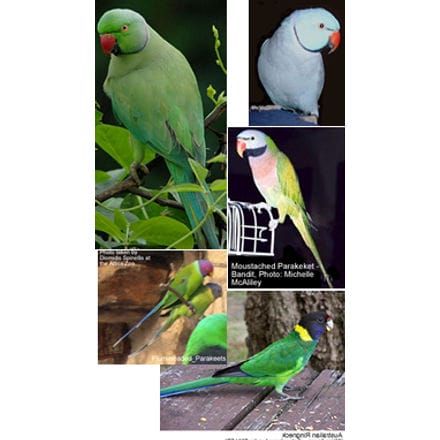
The vibrant and colorful ringneck parrot species are visually appealing and tame easily. Most of them readily breed in captivity resulting in an ample supply of young birds for the pet trade.
Owners describe them as smart birds that learn concepts quickly and love to show off. Many of them are very talented talkers, speaking with a clarity that can easily be compared to that of the Quakers, Grays and Amazons – species well known for their talking abilities.
Contrary to rumors, both the male and the female are capable of speech. They learn words and phrases in a very short span of time without any training for the most part. They just learn by listening. Of course, should training be provided, their vocabulary can be significantly increased.
Australian Ringneck Parrots … Ringneck Photo Gallery
Common Species:
- Alexandrine Parakeets
- Indian Ringnecks
- Moustached / Mustached / Java Parakeets
- Plum-headed Parakeets aka Plumheads
- Rose-ringed Parakeets
- Slaty-headed Parakeets
- Complete index of ringneck parrot species
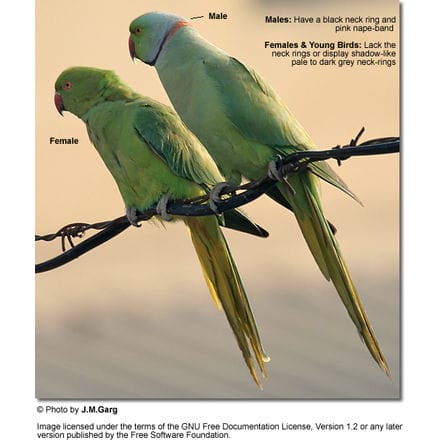
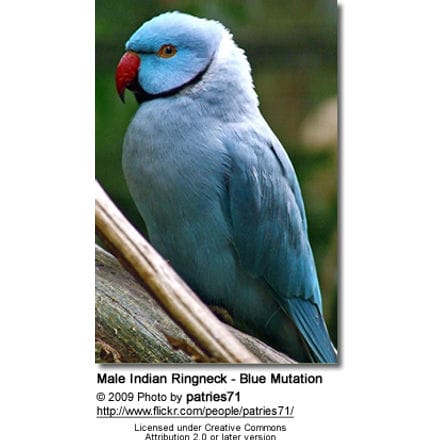
Ringneck Parrots as Pets: Typical Behavior, Training and Care
Nesting / Breeding
Within their natural range, Ringnecks mostly breed between February and March, although some breeding activities have been observed in April.
Most parrot species mate for life; however, this is not the case with the Ringnecks.
They nest in tree cavities – either natural or excavated by the birds themselves using their beaks and claws. If they excavated the nest cavity themselves, the entrance hole is usually a circular, ~2 inch + opening. They may use the deserted nests of Woodpeckers and Barbets. They may even take advantage of holes in old walls and buildings to make their nests in.
The average clutch consists of 2 – 6 whitish eggs. These eggs are incubated for about 22 – 24 days.
The young fledge when they are about 6 – 7 weeks old.

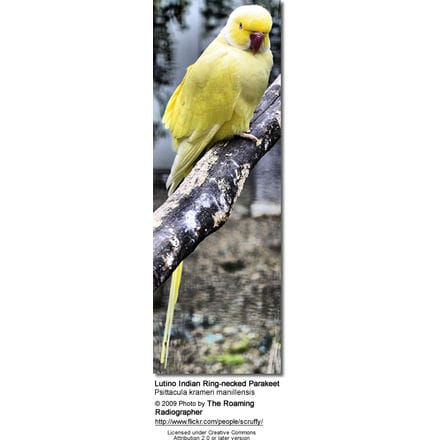
Aviculture
Ringnecks reach reproductive maturity when they are about 1 – 1 1/2 years old. However, they may not breed until they are 2 to 4 years old. Females may successfully start breeding as early as 1 year and males at 2 years.
These beautiful parakeets are generally hardy once established in an aviary. They are generally good parents and can be a good choices for those wishing to start breeding larger birds.
FREE Training to Stop Your Bird's Biting
Get FREE access to Beak School – the only system designed to train your bird. Stop behavioral problems like biting, screaming, feather plucking.
Get the Free TrainingSince they don’t form close pair bonds, they are easy to pair up, split up and re-pair, if necessary. The actual act of mating is preceded by a long and involved courtship that involves the male feeding the female, “dancing” and bowing.
Ringnecks will interbreed with related parrot species (for example, Indian Ringnecks may hybridize with Alexandrine Parakeet and the Moustached Parakeet).
Diet / Feeding of Ringneck Parrots
FREE Training to Stop Your Bird's Biting
Get FREE access to Beak School – the only system designed to train your bird. Stop behavioral problems like biting, screaming, feather plucking.
Get the Free TrainingRingneck Parrots are generally hardy birds. However, the following diseases have been reported in this species:
- Polyoma
- Sarcocystosis
- Aspergillosis (fungal disease)
- Bacterial infections (pneumonia)
- Hypovitaminosis A
- Psittacosis
Relevant Resources:
Photo, Video and/or Article contributions are welcome! You can Upload articles and images here. Thank you!
Beauty Of Birds strives to maintain accurate and up-to-date information; however, mistakes do happen. If you would like to correct or update any of the information, please contact us. THANK YOU!!!
