
Our complete list of all Lory and Lorikeet species with clickable links that will take you to even more in-depth information on that specific species of Lorikeet or Lory, images are included on all pages!
Includes Average Length, Clutch Size and Incubation Period
Below listed are Lory – Lorikeet Species
Format: Species Common Name / Scientific Name / Average Length / Average Clutch Size /
Arfak Alpine Lorikeets – Oreopsittacus arfaki arfaki
- Average Length (including tail): 15 cm / 6 in
- Average Clutch Size: 2 eggs
- Approx. Incubation: 22 days
Banded Lories or Dusky Lories – Pseudeos fuscatais / fuscata
FREE Training to Stop Your Bird's Biting
Get FREE access to Beak School – the only system designed to train your bird. Stop behavioral problems like biting, screaming, feather plucking.
Get the Free Training- Average Length (including tail): 25 cm / 10 in
- Average Clutch Size: 2-4 eggs
- Approx. Incubation: 24 days
Beaufort’s Black-capped Lories – Lorius or Domicella lory viridicrissalis
- Average Length (including tail): 31 cm / 12 in
- Average Clutch Size:1-2 eggs
- Approx. Incubation: 24 days
Bechstein’s Violet-necked Lories – Eos squamata riciniata
- Average Length (including tail): 26 cm / 10 in
- Average Clutch Size: 2 eggs
- Approx. Incubation: 25 cm-26 days
Bernstein’ s Black Lories – Chalcopsitta atra bernsteini
- Average Length: 34 cm or 13.5 in
- Average Clutch Size: 2 eggs
- Approx. Incubation: 24-25 days
Biak Red-spotted Lorikeets – Charmosyna rubronotata kordoana
- Average Length: 17 cm / 6.5 in
- Average Clutch Size: 2 eggs
- Approx. Incubation: 22-23 days
Bernstein’s Red Lories – Eos bornea bernsteini
- Average Length: 32 cm / 12.5 in
- Average Clutch Size: 2 eggs
- Approx. Incubation: 24-26 days
Biak Lories aka Biak Lories, Blue-nape Lories or Biak Blackcaps – Lorius lory cyanuchen
- Average Length (including tail): 33 cm / 13 in
- Average Clutch Size: 1-2 eggs
- Approx. Incubation: 24 days
Black-capped Lories – Lorius lory lory
- Average Length (including tail): 31 cm / 12.4 in
- Average Clutch Size: 2 eggs
- Approx. Incubation: 25 cm days
Black Lories – Chalcopsitta atra atra
- Average Length (including tail): 32 cm / 12.8 in
- Average Clutch Size: 2 eggs
- Approx. Incubation: 24-25 days
Black-winged Lories – Eos cyanogenia
- Average Length (including tail): 30 cm / 12 in
- Average Clutch Size: 2 eggs
- Average Length (including tail): 25 cm days
Blue-crowned Lories – Vini australis
- Average Length (including tail): 19 cm / 7.6 in
- Average Clutch Size: 2 eggs
- Approx. Incubation: 23 days
Blue-diademed Lories – Eos histrio histiro
- Average Length (including tail): 31 cm / 12.4 in
- Average Clutch Size: 2 eggs
- Approx. Incubation: 24 days
Blue-eared Lories – Ceram Lories – Eos semilarvata
- Average Length (including tail): 17 cm / 6.8 in
- Average Clutch Size: 2 eggs
- Approx. Incubation: 23 days
Blue-faced Lories – Trichoglossus haematodus intermedius
- Average Length (including tail): 26 cm / 10 in
- Average Clutch Size: 2 eggs
- Approx. Incubation: 24-27 day
Blue Mountain Lory – Trichoglossus haematodus moluccanus
- Average Length (including tail): 26 cm / 10.4 in
- Average Clutch Size: 2 eggs
- Approx. Incubation: 23 – 24 days
Blue-nape Lories aka Biak Lories, Biak Lories or Biak Blackcaps – Lorius lory cyanuchen
- Average Length (including tail): 33 cm / 13 in
- Average Clutch Size: 1-2 eggs
- Approx. Incubation: 24 days
Blue-streaked Lories – Eos reticulata
- Average Length (including tail): 31 cm / 12.4 in
- Average Clutch Size: 2 eggs
- Approx. Incubation: 25 cm days
Blue-thighed Lories or Blue-thighed Lories – Lorius domicellus / tibialis
- Average Length (including tail): 28 cm / 11.2 in
- Average Clutch Size: 2 eggs
- Approx. Incubation: 26 days
Black-throated aka Dark-throated Lorikeets – Trichoglossus haematodus nigrogularis
- Average Length (including tail): 28 cm / 11 in
- Average Clutch Size: 2 eggs
- Approx. Incubation: 24-27 days
Brook’s Lorikeets – Trichoglossus haematodus brooki
- Average Length (including tail): 26 cm / 10 in
- Average Clutch Size: 2 eggs
- Approx. Incubation: 24-27 days
Buru Red Lories – Eos b. cyanonothus
- Average Length (including tail): 28 cm / 11 in
- Average Clutch Size: 2-3 eggs
- Approx. Incubation: 26 days
Cardinal Lories – Chalcopsitta cardinalis
- Average Length (including tail): 31 cm / 12.4 in
- Average Clutch Size: 2 eggs
- Approx. Incubation: 24 days
Carmine-fronted Lories – Chalcopsitta sintillata sintillata
- Average Length (including tail): 24 cm / 9.6 in
- Average Clutch Size: 2 eggs
- Approx. Incubation: 24-26 days
Ceram Lories – Eos semilarvata
- Average Length (including tail): 17 cm / 6.8 in
- Average Clutch Size: 2 eggs
- Approx. Incubation: 23 days
Challanger’s Lories – Extinct? – Eos histrio challengeri
- Average Length (including tail): 31 cm / 12.4 in
- Average Clutch Size: 2 eggs
- Approx. Incubation: 24 days
Chattering Red Lories aka Moluccan Lories – Lorius garrulus
- Average Length (including tail): 30 cm / 12 in
- Average Clutch Size: 2 eggs
- Approx. Incubation: 26 days
Cherry-red Lorikeets (Ponapé Lory) – Trichoglossus haematodus rubiginosus
- Average Length (including tail): 28 cm / 11 in
- Average Clutch Size: 2 eggs
- Approx. Incubation: 24-25 days
Coconut Lories – Trichoglossus haematodus massena
- Average Length (including tail): 25 cm-26 cm / 10 in
- Average Clutch Size: 2 eggs
- Approx. Incubation: 24-27 days
Collared Lories aka Solitary Lory or Ruffed Lory – Phigys solitarius
- Average Length (including tail): 20 cm / 8 in
- Average Clutch Size: 2 eggs
- Approx. Incubation: 28 – 30 days
Dark-throated Lorikeets – Trichoglossus haematodus nigrogularis
- Average Length (including tail): 28 cm / 11 in
- Average Clutch Size: 2 eggs
- Approx. Incubation: 24-27 days
Deplanche’s or Deplanchi’s Lorikeets – Trichoglossus haematodus deplanchii
- Average Length (including tail): 26 cm / 10 in
- Average Clutch Size: 2 eggs
- Approx. Incubation: 24-27 days
Djampea Lorikeets – Trichoglossus haematodus djampeanus
- Average Length (including tail): 26 cm / 10 in
- Average Clutch Size: 2 eggs
- Approx. Incubation: 24-27 days
Duchess Lorikeets – Charmosyna margarethae
- Average Length (including tail): 20 cm / 7.8 in
- Average Clutch Size: ?
- Approx. Incubation: ?
Dusky Lories – Pseudeos fuscatais / fuscata
- Average Length (including tail): 25 cm / 10 in
- Average Clutch Size: 2-4 eggs
- Approx. Incubation: 24 days
Duyvenbode’s Lories – Chalcopsitta duivenbodei
- Average Length (including tail): 31 cm / 12.4 in
- Average Clutch Size: 2 eggs
- Approx. Incubation: 24 days
Edward’s Lorikeets – Trichoglossus haematodus capistratus
- Average Length (including tail): 27 cm / 10.8 in
- Average Clutch Size: 2 eggs
- Approx. Incubation: 24-27 days
Emerald Lorikeets or Orange-billed Lorikeets – Neopsittacus pullicauda
- Average Length (including tail): 18 cm / 7.2 in
- Average Clutch Size: 2 eggs
- Approx. Incubation:?
Fairy Lorikeets – Charmosyna pulchella pulchella
- Average Length (including tail): 18 cm / 7.2 in
- Average Clutch Size: 2 eggs
- Average Length (including tail): 25 cm days
Fergusson Island Lories – Lorius hypoinochrous devittatus
- Average Length (including tail): 27 cm / 10.5 in
- Average Clutch Size: 2 eggs
- Average Length (including tail): 25 cm-26 days
Forsten’s Lorikeets – Trichoglossus haematodus
- Average Length (including tail): 25 cm-26 cm / 10 in
- Average Clutch Size: 2 eggs
- Approx. Incubation: 22-25 days
| Clicking on the name will take you to the respective species information | Scientific Name: | Average Length | Average Clutch Size | Approx. Incubation |
| Fairy Lorikeets | Charmosyna pulchella pulchella | 18 cm / 7.2 in | 2 eggs | 25 days |
| Fergusson Island Lories | Lorius hypoinochrous devittatus | 27 cm / 10.5 in | 2 eggs | 25-26 days |
| Forsten’s Lorikeets | Trichoglossus haematodus | 25-26 cm / 10 in | 2 eggs | 22-25 days |
| Gold and Green Lorikeets or Scaly-breasted Lorikeets | Trichoglossus chlorolepidotus | 21-23 cm / 8.4-9 in | 2 eggs | 22 – 25 days |
| Golden-banded Lorikeets or Red-throated Lorikeets | Charmosyna rubrigularis rubrigularis | 17 cm / 6.8 in | ? | ? |
| Goldie’s Lorikeets | Trichoglossus goldei | 19 cm / 7.6 in | 2 eggs | 23 days |
| Greater Alpine Lorikeets | Oreopsittacus arfaki arfaki | 15 cm / 6 in | 2 eggs | 22 days |
| Greater Red Lories or Bernstein Red Lories | Eos bornea bernsteini | 32 cm / 12.5 in | 2 eggs | 24-26 days |
| Green-naped Lories or Rainbow Lories | Trichoglossus haematodus haematodus | 29 cm / 11.6 in | 2 eggs | 24 days |
| Green-streaked Lories | Chalcopsitta sintillata chloroptera | 31 cm / 12 in | 2 eggs | 24-25 days |
| Halmahera Red-flanked Lorikeets | Charmosyna placentis intensior | 17-17.5 cm / 7 in | 2-3 eggs | ? |
| Hartert’s Fairy Lorikeets | Charmosyna pulchella rothschild | 18.5 cm / 7.25 in | 2 eggs | 25 days |
| Huon Emerald Lorikeets | Neopsittacus pullicauda sociales | 18 cm / 7 in | 2 eggs | ? |
| Henderson Lorikeets or Stephens Lories | Vini stepheni | 19 cm / 7.6 in | 3-4 eggs | 23-26 days |
| Indian Lorikeets | Loriculus vernalis | ~13-14 cm or 5 inches | 2-3 eggs | 20 days |
| Iris Lorikeets | Trichoglossus iris | 20 cm / 8 in | 2 eggs | 23 days |
| Jobi Lories | Lorius lory jobiensis | 31 cm / 12.4 in | 1-2 eggs | 24 days |
| Johnstone’s Lories | Trichoglossus j. johnstoniae | 20 cm / 8 in | 2 eggs | 23-25 days |
| Josephine’s Lorikeets | Charmosyna josefinae | 24 cm / 9.6 in | 2 eggs | 25 days |
| Karkar Red-chinned Lorikeets | Charmosyna rubrigularis krakari | 17 cm / 6.7 in | ? | ? |
| Kuhl’s Lories or Kuhl’s Ruffed Lory | Vini kuhlii | 19 cm / 7.6 in | 2 eggs | ? |
| Little Lorikeets | Glossopsitta pusilla | 15 cm / 6 in | 3-5 eggs | 20 days |
| Louisiade Lories or Purple-bellied Lory | Lorius hypoinochrous hypoinochrous | 26 cm / 10-10.4 in | 2 eggs | 25-26 days |
| Maju Violet-necked Lories | Eos s. atrocaerulea | 26 cm / 10 in | 2 eggs | 25-26 days |
| Malay Lorikeets | Loriculus galgulus | 12-13 cm / 4-5 in | 3-4 eggs | 20 days |
| Mamberiok Black Lories | Chalcopsitta atra spectabilis | 32 cm / 12.5 in | 2 eggs | 24-25 days |
| Marquesas Lories (Ultramarine Lory) | Vini ultramarina | 17-18 cm / 7 in | 2 eggs | 25 days |
| Massena’s Lorikeets (Coconut Lory) | Trichoglossus haematodus massena | 25 cm / 10 in | 2 eggs | 24-27 days |
| Mayr’s Red-flanked Lorikeets | Charmosyna placentis ornata | 17-18 cm / 7 in | 2 eggs | 21-23 days |
| Meek’s Lorikeets | Charmosyna meeki | 16 cm / 6.4 in | ? | ? |
| Meyer’s Black-capped Lories | Lorius l. salvadorii | 31 cm / 12 in | 2-3 eggs | 26 days |
| Meyer’s Lorikeets | Trichoglossus flavoviridus | 27 cm / 10.8 in | 2 eggs | 23 days |
| Mitchell’s Lorikeets | Trichoglossus haematodus mitchellii | 24 cm / 9.5 in | 2 eggs | 24-27 days |
| Mollucan Lories | Eos bornea | 31 cm / 12.4 in | 2 eggs | 24 days |
| Morotai Yellow-backed Lories | Lorius garrulus morotaianus | 30 cm / 12 in | 2 eggs | 26-28 days |
| Mount Goliath Lorikeets | Charmosyna p. goliathina | 45 cm / 17.75 in | 2 eggs | 28 days |
| Mount-Apo Lories (Johnstone’s Lories) | Trichoglossus johnstoniae | 20 cm / 8 in | 2 eggs | 23-25 days |
| Musschenbroek’s Lorikeets (Yellow-billed Lorikeets) | Neopsittacus musschenbroekii | 23 cm / 9.2 in | 2 eggs | 23-26 days |
| Musk Lorikeets | Glossopsitta concinna | 22 cm / 8.8 in | 2 eggs | 22 days |
| New Caledonia Lories or Deplanche’s Lorikeets | Trichoglossus haematodus deplanchii | 26 cm / 10 in | 2 eggs | 24-27 days |
| New Caledonian Lorikeets | Charmosyna diadema | 18 cm / 7.2 in | Extinct | |
| Neumann’s Brown Lories aka Neumann’s Duyvenbode’s Lories | Chalcopsitta duivenbodei syringanuchalis | 31 cm / 12 in | 2 eggs | 25 days |
| Ninigo Lorikeets | Trichoglossus haematodus nesophilus | 26 cm / 10 in | ? | ? |
| Obi Violet-necked Lories | Eos s. obiensis | 26 cm / 10 in | 2-3 eggs | 26 days |
| Orange Lorikeets or Emerald Lorikeets | Neopsittacus pullicauda | 18 cm / 7-7.2 in | 2 eggs | ? |
| Orange-breasted Emerald Lorikeets | Neopsittacus pullicauda alpinus | 18 cm / 7-7.2 in | 2 eggs | ? |
| Olive-green Lorikeets | Trichoglossus haematodus flavicans | 27 cm / 10.5 in | 2 eggs | 24 days |
| Ornate Lories or Ornate Lorikeets | Trichoglossus ornatus | 25 cm / 10 in | 2 eggs | 25 days |
Rainbow Lories / Lorikeets (Green Naped) aka Green Naped Lories / Lorikeets – Trichoglossus haematodus haematodus
- Average Length (including tail): 29 cm / 11.6 in
- Average Clutch Size: 2 eggs
- Approx. Incubation: 24 days
Rainbow Lories / Lorikeets aka Swainson’s Blue Mountain, Swainson’s Blue Mt. Lorikeet, Swainson’s Lory, Blue Mountain Lories – Trichoglossus haematodus moluccanus
- Average Length (including tail): 26 cm / 10.4 in
- Average Clutch Size: 2 eggs
- Approx. Incubation: 23 – 24 days
Rajah Lories – Chalcopsitta atra insignis
- Average Length (including tail): 31 cm / 12.4 in
- Average Clutch Size: 2 eggs
- Approx. Incubation: 25 days
Red and Blue Lories – Eos histrio histiro
- Average Length (including tail): 31 cm / 12.4 in
- Average Clutch Size: 2 eggs
- Approx. Incubation: 24 days
Red-breasted Lories or Salvadory Black-capped Lories- Trichoglossus haematodus mitchelli
- Average Length (including tail): 20 cm / 8 in
- Average Clutch Size: 2 eggs
- Approx. Incubation: 22-25 days
Red-chinned Lorikeets – Charmosyna rubrigularis rubrigularis
- Average Length (including tail): 17 cm / 6.5-7 in
- Average Clutch Size: ?
- Approx. Incubation: ?
Red-collared Lorikeets – Trichoglossus haematodus rubritorquis
- Average Length (including tail): 26-28 cm / 10.4-11 in
- Average Clutch Size: 2 eggs
- Approx. Incubation: 24-25 days
Red-crowned Lorikeets – Trichoglossus versicolor
- Average Length (including tail): 18-19 cm / 7-7.5 in
- Average Clutch Size: 2-5 eggs
- Approx. Incubation: 22 days
Red-flanked Lorikeets – Charmosyna placentis placentis
- Average Length (including tail): 17 cm / 6.5-7 in
- Average Clutch Size: 2 eggs
- Approx. Incubation: 23 days
Red-fronted Lories or Carmine-fronted Lories – Chalcopsitta sintilla rubrifrons
- Average Length (including tail): 31 cm / 12.4 in
- Average Clutch Size: 2 eggs
- Approx. Incubation: 24-26 days
Red Lories – Eos bornea
- Average Length (including tail): 31 cm / 12.4 in
- Average Clutch Size: 2 eggs
- Approx. Incubation: 24 days
Red Lorikeets or Ponape Lories – Trichoglossus rubiginosus
- Average Length (including tail): 24 cm / 9.6 in
- Average Clutch Size: 1-2 eggs
- Approx. Incubation: 24 days
Red-rumped or Red-spotted Lorikeets – Charmosyna rubronotata rubronotata
- Average Length (including tail): 17 cm / 6.5-7 in
- Average Clutch Size: 2 eggs
- Approx. Incubation: ?
Red-throated Lorikeets – Charmosyna rubrigularis rubrigularis
- Average Length (including tail): 17 cm / 6.5-7 in
- Average Clutch Size: ?
- Approx. Incubation: ?
Rosenberg’s Lorikeets – Trichoglossus haematodus rosenbergi
- Average Length (including tail): 26-30 cm / 10-12 in
- Average Clutch Size: 2 eggs
- Approx. Incubation: 22-25 days
Rossel Island Lories – Lorius hypoinochrous rosselianus
- Average Length (including tail): 26 cm / 10 in
- Average Clutch Size: ?
- Approx. Incubation: ?
Rothschild’s Red Lories – Eos bornea rothschildi
- Average Length (including tail): 28 cm / 11 ins
- Average Clutch Size: 2 eggs
- Approx. Incubation: 24-26 days
Ruby-capped Lorikeets – Psitteuteles iris rubripileum
- Average Length (including tail): 20 cm / 8 in
- Average Clutch Size: 2-3 eggs
- Approx. Incubation: ?
Ruffed Lories or Solitary Lories – Phigys solitarius
- Average Length (including tail): 20 cm / 8 in
- Average Clutch Size: 2 eggs
- Approx. Incubation: 28 days
Salvadory Black-capped Lories – Psittaculirostris salvadori
- Average Length (including tail): 19 cm / 7.6 in
- Average Clutch Size: 2 eggs
- Approx. Incubation: 22 days
Scaly-breasted Lorikeets – Trichoglossus chlorolepidotus
- Average Length (including tail): 21-23 cm / 8.4-9 in
- Average Clutch Size: 2 eggs
- Approx. Incubation: 22-25 days
Sclater’s Red-flanked Lorikeets – Charmosyna placentis subplacens
- Average Length (including tail): 17 cm / 7 in
- Average Clutch Size: 2 eggs
- Approx. Incubation: ?
Sepik Lorikeets – Charmosyna josefinae sepikiana
- Average Length (including tail): 24 cm / 9.5 in
- Average Clutch Size: 2 eggs
- Approx. Incubation: 25 days
Solitary or Collared Lories – Phigys solitarius
- Average Length (including tail): 20 cm / 8 in
- Average Clutch Size: 2 eggs
- Approx. Incubation: 28 days
Solomon Island Red-flanked Lorikeets – Charmosyna placentis pallidior
- Average Length (including tail): 17 cm / 7 in
- Average Clutch Size: 2 eggs
- Approx. Incubation: 22-23 days
Somu Lories – Lorius l. somu
- Average Length (including tail): 29 cm / 11.5 in
- Average Clutch Size: 2-3 eggs
- Approx. Incubation: 26 days
Southern Alpine Lorikeets – Oreopsittacus arfaki grandis
FREE Training to Stop Your Bird's Biting
Get FREE access to Beak School – the only system designed to train your bird. Stop behavioral problems like biting, screaming, feather plucking.
Get the Free Training- Average Length (including tail): 15 cm / 6 in
- Average Clutch Size: 2 eggs
- Approx. Incubation: 22 days
Southern Green-naped Lorikeets – Trichoglossus haematodus micropteryx
- Average Length (including tail): 25 cm / 9.5 in
- Average Clutch Size: 2 eggs
- Approx. Incubation: 24-27 days
Southern Musschenbroek’s Lorikeets – Neopsittacus musschenbroekii major
- Average Length (including tail): 24 cm / 9.5 in
- Average Clutch Size: 2 eggs
- Approx. Incubation: 23 – 26 days
Stella’s Lorikeets – Charmosyna papou stellae
- Average Length (including tail): 42 cm / 16.8 in
- Average Clutch Size: 2 eggs
- Approx. Incubation: 26 days
Stephen’s Lories – Vini stepheni
- Average Length (including tail): 19 cm / 7.6 in
- Average Clutch Size: 3-4 eggs
- Approx. Incubation: 23 – 26 days
Stresemann’s Lories – Lorius amabilis / Lorius hypoinochrous devittatus
- Average Length (including tail): 26 cm or 10 in
- Extinct?
Stresemann’s Lorikeets – Trichoglossus haematodus stresemanni
- Average Length (including tail): 26 cm / 10 in
- Average Clutch Size: 2 eggs
- Approx. Incubation: 24 days
Striated Lorikeets – Charmosyna multistriata
- Average Length (including tail): 18 cm / 7.2 in
- Average Clutch Size: 2 eggs
- Approx. Incubation: 25 days
Sula Lorikeets – Trichoglossus flavoviridus flavoviridus
- Average Length (including tail): 20 cm / 7.8 in
- Average Clutch Size: 2 eggs
- Approx. Incubation: 23 days
Sumba Lorikeets – Trichoglossus haematodus fortis
- Average Length (including tail): 26 cm / 10 in
- Average Clutch Size: 2 eggs
- Approx. Incubation: 24 days
Swainson’s / Swainson’s Blue Lories or Swainson’s Blue Mountain Lorikeets – Trichoglossus haematodus moluccanus
- Average Length (including tail): 26 cm / 10.4 in
- Average Clutch Size: 2 eggs
- Approx. Incubation: 23 – 24 days
Tahitian Lories or Tahiti Blue Lories – Vini peruviana
- Average Length (including tail): 18 cm / 7.2 in
- Average Clutch Size: 2 eggs
- Approx. Incubation: 25 days
Talaud Red and Blue Lories – Eos histrio talautensis
- Average Length (including tail): 31 cm / 12.4 in
- Average Clutch Size: 2 eggs
- Approx. Incubation: 24 days
Ultramarine Lories – Vini ultramarina
- Average Length (including tail): 18.5 cm / 7.4 in
- Average Clutch Size: 2 eggs
- Approx. Incubation: 25 days
Van Oort Black Lories (Mamberiok Black Lory) – Chalcopsitta atra spectabilis
- Average Length (including tail): 32 cm / 12.5 in
- Average Clutch Size: 2 eggs
- Approx. Incubation: 24-25 days
Varied Lorikeets – Trichoglossus versicolor
- Average Length (including tail): 18-19 cm / 7-7.5 in
- Average Clutch Size: 2-5 eggs
- Approx. Incubation: 22 days
Victoria Lories or Southern Alpine Lorikeets – Oreopsittacus arfaki arfaki
- Average Length (including tail): 15 cm / 6 in
- Average Clutch Size: 2 eggs
- Approx. Incubation: 22 days
Violet-necked Lories – Eos squamata
- Average Length (including tail): 27 cm / 10.8 in
- Average Clutch Size: 2 eggs
- Approx. Incubation: 25 days
Wahne’s Lorikeets – Charmosyna p. wahnesi
- Average Length (including tail): 42 cm / 16.5 in
- Average Clutch Size: 2 eggs
- Approx. Incubation: 28 days
Weber’s Lorikeets – Trichoglossus haematodus weberi
- Average Length (including tail): 23 cm / 9.2 in
- Average Clutch Size: 2-3 eggs
- Approx. Incubation: 25 days
Wedge-tailed Lorikeets – Psitteuteles iris iris
- Average Length (including tail): 20 cm / 8 in
- Average Clutch Size: 2-3 eggs
- Approx. Incubation: ?
Western Mount Apo Lorikeets – Trichoglossus johnstoniae pistra
- Average Length (including tail): 20 cm / 7.8 in
- Average Clutch Size: 2 eggs
- Approx. Incubation: 23 days
Western Musschenbroek’s Lorikeets – Neopsittacus musschenbroekii medius
- Average Length (including tail): 23-25 cm or 9-10 in
- Average Clutch Size: 2 eggs
- Approx. Incubation: 23 – 26 days
Wetar Lorikeets – Trichoglossus haematodus flavotectus
- Average Length (including tail): 26-27 cm / 10 in
- Average Clutch Size: 2 eggs
- Approx. Incubation: 24-27 days
White-naped or White-necked Lories – Lorius albidinucha
- Average Length (including tail): 26-28 cm / 11 in
- Average Clutch Size: ?
- Approx. Incubation: ?
Whiskered Lorikeets – Oreopsittacus arfaki arfaki
- Average Length (including tail): 15 cm / 6 in
- Average Clutch Size: 2 eggs
- Approx. Incubation: 22 days
Wilhelmina’s Lorikeets – Charmosyna wilhelminae
- Average Length (including tail): 13 cm / 5.2 in
- Average Clutch Size: 2 eggs
- Approx. Incubation: 23 days
Yellow-backed Lories – Lorius garrulus flavopalliatus
- Average Length (including tail): 30 cm / 12 in
- Average Clutch Size: 2 eggs
- Approx. Incubation: 26 days
Yellow-bibbed or Yellow-collared Lories – Lorius chlorocercus
- Average Length (including tail): 28 cm / 11.2 in
- Average Clutch Size: 2 eggs
- Approx. Incubation: 25 days
Yellow-billed Lorikeets – Neopsittacus musschenbroekii
- Average Length (including tail): 23 cm / 9.2 in
- Average Clutch Size: 2 eggs
- Approx. Incubation: 23 – 26 days
Yellow & Green Lorikeets – Trichoglossus flavoviridus flavoviridus
- Average Length (including tail): 20 cm / 7.8 in
- Average Clutch Size: 2 eggs
- Approx. Incubation: 23 days
Yellow-headed Lorikeets – Trichoglossus euteles
- Average Length (including tail): 25 cm / 9.75 in
- Average Clutch Size: 3 eggs
- Approx. Incubation: ?
Yellow-streaked Lories – Chalcopsitta sintilla sintilla
- Average Length (including tail): 31 cm / 12.4 in
- Average Clutch Size: 2 eggs
- Approx. Incubation: 24 days
Yellow-streaked Lorikeets or Striated Lorikeets – Charmosyna multistriata
- Average Length (including tail): 18 cm / 7.2 in
- Average Clutch Size: 2 eggs
- Approx. Incubation: 25 days
Beauty Of Birds strives to maintain accurate and up-to-date information; however, mistakes do happen. If you would like to correct or update any of the information, please contact us. THANK YOU!!!
Lories (Chalcopsitta / Eos / Lorius / Vini) and Lorikeets (Charmosyna, Glossopsitta, Neopsittacus)
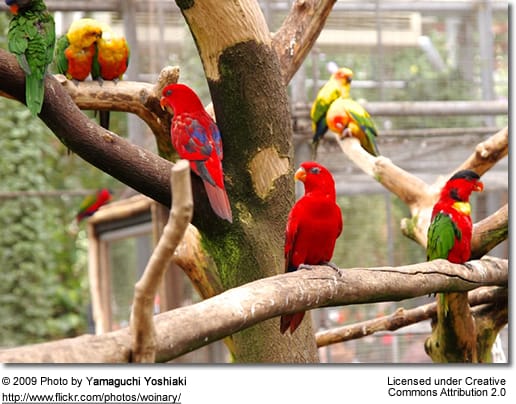
Lories and Lorikeets can be found throughout the islands of the South Pacific and Australia. Nearly all of these birds have been impacted to varying degrees by habitat destruction due to logging and conversion for agricultural purposes; as well as capturing of the nestlings and adults for the exotic pet trade.
Latin Names / Families: Lories: Chalcopsitta / Eos / Lorius / Vini and Lorikeets: Charmosyna, Glossopsitta, Neopsittacus
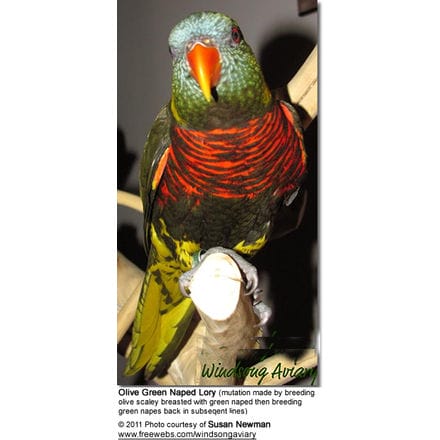
In Australia, they are often all collectively called “lories.” However, there are some distinctive differences between Lories and Lorikeets:
- Tails: Species with longer tapering tails are generally referred to as “lorikeets” and those with short, rounded or square tails as “lories.”
- Size: Lories tend to be bigger in size than lorikeets.
- Plumage: Most lories are red with patches of yellow, purple, and green. Most lorikeets are green with patches of red and yellow. There are some exceptions to this rule.
They are also known as honeyeaters or “brush-tongued” parrots. The latter nickname relates to their very specialized tongues with tiny hair-like structures ( ‘papillae’) at the end in the shape of an “U”.
As these birds extend their tongues to feed, the papillae stand on end – like bristles on a brush – soaking up nectar and pollen of any flowers or scraping the inside of fruits to collect the sweet juices.
FREE Training to Stop Your Bird's Biting
Get FREE access to Beak School – the only system designed to train your bird. Stop behavioral problems like biting, screaming, feather plucking.
Get the Free TrainingThese parrots have been observed feeding on over 600 flowers over one day. They are very important for the pollination of many species of tropical plants, which might perish without these “services”.
The shape of their beaks also differ from those of other parrots. Their upper bill has a long, pointed tip and is much narrower structure than that of other parrots, allowing them to easily extract hard-to-reach seeds from cones and other vegetation.
Their very specific dietary requirements sets them apart from other parrot species. Their mostly “liquid” diet makes them messy to keep in homes unless accommodations have been put into place to allow for easy clean-up.
Lorikeet Species, Distribution / Ranges
Diet / Feeding
In the wild, they mostly feed on nectar, flowers, fruits, pollen and seeds.
Breeding / Nesting
Lories and lorikeets usually stay with one partner and may breed at any time of year. Though in southern Australia the breeding season is between August and January. Nest sites are high above the ground in the hollows of trees, which the birds layer with a covering of decayed wood.
The female and male will often roost together, but only the female will sit on her two small white eggs. However, the male will help feed the chicks, which hatch with eyes closed and no feathers. The chicks will slowly grow plumage and be able to fly after seven to eight weeks.
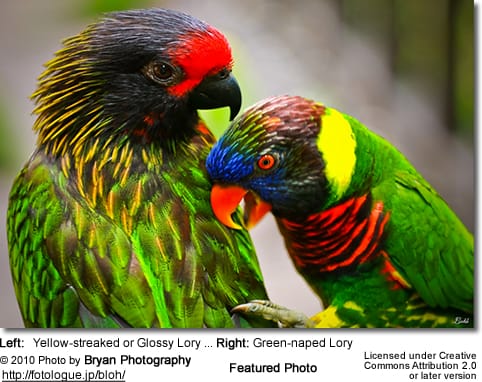
- Lories and Lorikeets: Overview (Naming, Range and Description) – Please Scroll Down … Listing of Species … Photos of the Different Lory Species for Identification
- Lories & Lorikeets in Aviculture … Lorikeets as Pets … Feeding and Caring for Your Lories and Lorikeets … Housing Lorikeets … Diseases of Lories / Lorikeets & Health Care Program
Beauty Of Birds strives to maintain accurate and up-to-date information; however, mistakes do happen. If you would like to correct or update any of the information, please contact us. THANK YOU!!!
Lorikeets: Genus: Charmosyna
Lorikeets: Species, Distribution / Ranges
| Genus: Charmosyna | |
| Biak Red-spotted Lorikeets (Charmosyna rubronotata kordoana) | Biak Island, the largest of the Schouten Islands, off the northern coast of West Papua (the Indonesian part of New Guinea) at the entrance to Cenderawasih (Geelvink) Bay (part of Maluku Islands) |
| Duchess Lorikeets (Charmosyna margarethae) | Papua New Guinea and Solomon Islands |
| Fairy Lorikeets (Charmosyna pulchella pulchella) | New Guinea |
| Golden-banded Lorikeets or Red-throated Lorikeets (Charmosyna rubrigularis rubrigularis) | New Britain, New Ireland |
| Halmahera Red-flanked Lorikeets (Charmosyna placentis intensior) | Northern Moluccan / Maluku Islands, including Halmahera Island (the largest island in the Maluku Islands), Obi and Gebe, Indonesia |
| Hartert’s Fairy Lorikeets (Charmosyna pulchella rothschild) | Western New Guinea |
| Josephine’s Lorikeets (Charmosyna josefinae) | Indonesia and Papua New Guinea |
| Karkar Red-chinned Lorikeets (Charmosyna rubrigularis krakari) | Karkar Island, Papua New Guinea |
| Mayr’s Red-flanked Lorikeets (Charmosyna placentis ornata) | Western Papua Islands |
| Mount Goliath Lorikeets (Charmosyna p. goliathina) | Mountains of central New Guinea |
| New Caledonian Lorikeets (Charmosyna diadema) | New Caledonia |
| Palm or Green Palm Lorikeets (Charmosyna palmarum) | Have a fluctuating range in the Santa Cruz islands of the Solomon Islands and in Vanuatu |
| Papuan Lorikeets (Charmosyna papou papou) | New Guinea / mountains of Vogelkop Peninsular, Irian Jaya, Indonesia |
| Pleasing Lorikeets (Charmosyna placentis placentis) | Seram, Pandjang, Ambelau; Kai and Aru Islands (Maluku Province) ; southern New Guinea east to upper reaches of Purari River, Papua-New Guinea; formerly also on Ambon |
| Red-chinned Lorikeets (Charmosyna rubrigularis rubrigularis) | New Britain, New Ireland and Karkar Island off northern coast of New Guinea |
| Red-flanked Lorikeets (Charmosyna placentis placentis) | Seram, Pandjang, Ambelau; Kai and Aru Islands (Maluku Province); southern New Guinea east to upper reaches of Purari River, Papua-New Guinea; formerly also on Ambon |
| Red-rumped or Red-spotted Lorikeets (Charmosyna rubronotata rubronotata) | Salawati, Indonesia and northwest New Guinea |
| Red-throated Lorikeets (Charmosyna rubrigularis rubrigularis) | New Britain, New Ireland |
| Sclater’s Red-flanked Lorikeets (Charmosyna placentis subplacens) | Eastern and northern New Guinea west to Bereina area and south to Sarmi District, Irian Jaya, Indonesia |
| Sepik Lorikeets (Charmosyna josefinae sepikiana) | Mountains of Sepik region, from Vogelkop Peninsula east to Snow Mountains, Irian Jaya, Indonesia and western Papua New Guinea |
| Solomon Island Red-flanked Lorikeets (Charmosyna placentis pallidior) | Eastern and northern New Guinea west to Bereina area and south to Sarmi District, Irian Jaya, Indonesia, Bismarck Archipelago, Solomon Island (Bougainville and Fead) |
| Stella’s Lorikeets (Charmosyna papou stellae) | New Guinea |
| Striated Lorikeets (Charmosyna multistriata) | Western New Guinea |
| Wahne’s Lorikeets (Charmosyna p. wahnesi) | Mountains of Huon Peninsular and Adelbert Mountains, Papua New Guinea |
| Wilhelmina’s Lorikeets (Charmosyna wilhelminae) | New Guinea |
| Yellow-streaked Lorikeets or Striated Lorikeets (Charmosyna multistriata) | Western New Guinea |
- Lories and Lorikeets: Overview (Naming, Range and Description) – Please Scroll Down … Listing of Species … Photos of the Different Lory Species for Identification
- Lories & Lorikeets in Aviculture … Lorikeets as Pets … Feeding and Caring for Your Lories and Lorikeets … Housing Lorikeets … Diseases of Lories / Lorikeets & Health Care Program
Lories – Genus: Eos: Species, Distribution / Ranges
if you are looking for Lory Information with Lory Photo Gallery Genera of Lories, here at Beauty of Birds you can get all the Lory information.
Lory Information … Lory Photo Gallery
Genera of Lories:
Eos – please scroll down
Other Lory genera: Chalcopsitta / Lorius / Vini / Pseudeos / Phigys ( Fiji islands, Lau Archipelago) and Loriculus & Psitteuteles
| Genus: Eos | |
| Bechstein’s Violet-necked Lories (Eos squamata riciniata) | Weda Islands and Islands of the Northern Moluccas / Maluku, Indonesia |
| Bernstein’s Red Lories (Eos bornea bernsteini) | Kai Islands (also known as Kei Islands) – found in the south-eastern part of the Maluku Islands in Indonesia |
| Black-winged Lories (Eos cyanogenia) | New Guinea |
| Blue-diademed Lories (Eos histrio histiro) | Islands of Sangihe and Talaud and some of their outliers off northern Sulawesi, Indonesia |
| Blue-eared Lories – Ceram Lories (Eos semilarvata) | New Guinea, Aru Islands (Maluku province), Papuan Islands (Eastern Indonesia) |
| Blue-streaked Lories (Eos reticulata) | New Guinea |
| Blue-tailed Lories (Eos historio) | New Guinea |
| Buru Red Lories (Eos b. cyanonothus) | New Guinea |
| Ceram Lories (Eos semilarvata) | New Guinea, Aru Islands in the province of Maluku, Papuan Islands (Eastern Indonesia) |
| Challanger’s Lories (Eos histrio challengeri) | Nenusa Islands, Indonesia |
| Greater Red Lories or Bernstein Red Lories (Eos bornea bernsteini aka Eos rubra bernsteini) | Kai Islands (also known as Kei Islands) – found in the south-eastern part of the Maluku Islands in Indonesia |
| Maju Violet-necked Lories (Eos s. atrocaerulea) | Maju Island, Indonesia |
| Mollucan Lories (Eos bornea) | Indonesia |
| Obi Violet-necked Lories (Eos s. obiensis) | Island of Obi (northern islands of the Moluccas) |
| Red and Blue Lories (Eos histrio histiro) | Islands of Sangihe and Talaud and some of their outliers off northern Sulawesi, Indonesia |
| Rothschild’s Red Lories (Eos b. rothschildi) | Seram (formerly Ceram, also called Seran or Serang) is an island in the Maluku province of Indonesia |
| Talaud Red and Blue Lories (Eos histrio talautensis) | Talaud Islands – a group of islands located north of Sulawesi island in Indonesia. The Talaud Islands are also the northernmost region of Indonesia, bordering the Philippines. |
| Violet-necked Lories (Eos squamata) | New Guinea |
Species Research by Sibylle Johnson
Lories: Species, Distribution / Ranges
If you are looking for Lory Information, here at Beauty of Birds you can access Lory Photo Gallery Chalcopsitta (mostly found in New Guinea) / Eos / Lorius / Vini / Pseudeos / Phigys ( Fiji islands, Lau Archipelago) and Loriculus & Psitteuteles.
Lory Information … Lory Photo Gallery
Genera of Lories:
Chalcopsitta (mostly found in New Guinea) / Eos / Lorius / Vini / Pseudeos / Phigys ( Fiji islands, Lau Archipelago) and Loriculus & Psitteuteles
| Common & Scientific Names: | Native Range |
| Genus: Lorius | |
| Beaufort’s Black-capped Lories (Lorius or Domicella lory viridicrissalis) | Northern New Guinea |
| Biak Lories aka Biak Lories, Blue-nape Lories or Biak Blackcaps (Lorius lory cyanuchen) | Island of Biak in Geelvink Bay, Western New Guinea |
| Black-capped Lories (Lorius lory lory) | New Guinea |
| Blue-nape Lories aka Biak Lories, Biak Lories or Biak Blackcaps (Lorius lory cyanuchen) | Island of Biak in Geelvink Bay, Western New Guinea |
| Blue-thighed Lories or Blue-thighed Lories (Lorius domicellus / tibialis) | Seram and Ambon Islands, part of the Maluku Islands of Indonesia |
| Chattering Red Lories aka Moluccan Lories (Lorius garrulus) | Halmahera Island (the largest island in the Maluku Islands, Indonesia) |
| Fergusson Island Lories (Lorius hypoinochrous devittatus) | Trobriand and Woodlark Islands, Bismarck and D’Entrecastreaux Archipelagos, south-eastern New Guinea |
| Jobi Lories (Lorius lory jobiensis) | New Guinea |
| Louisiade Lories or Purple-bellied Lory (Lorius hypoinochrous hypoinochrous) | Misima and Tagula in Louisiade Archipelago, Eastern Papuan Island, New Guinea |
| Meyer’s Black-capped Lories (Lorius l. salvadorii) | Northern New Guinea from Aitape area to Astrolabe Bay |
| Morotai Yellow-backed Lories (Lorius garrulus morotaianus) | Morotai and Raou Islands (Maluku Islands) |
| Purple-bellied Lories (Lorius hypoinochrous) | New Guinea |
| Purple-naped or Blue-thighed Lories (Lorius domicellus) | Seram, Ambon Island, part of the Maluku Islands of Indonesia |
| Rossel Island Lories (Lorius hypoinochrous rosselianus) | Rossel Island in Louisiada Archipelago |
| Somu Lories (Lorius l. somu) | Southern New Guinea from Karimui Basin to Ok Tedi area |
| Stresemann’s Lories (Lorius amabilis / Lorius hypoinochrous devittatus) | New Britain in the Bismarck Archipelago – Extinct? |
| White-naped or White-necked Lories (Lorius albidinucha) | New Britain |
| Yellow-backed Lories (Lorius garrulus flavopalliatus) | Islands of Batjan and Obi, part of Maluku Islands |
| Genus: Pseudeos | |
| Banded Lories or Dusky Lories (Pseudeos fuscatais / fuscata) | Indonesia and Papua New Guinea |
| Dusky Lories (Pseudeos fuscatais / fuscata) | Indonesia and Papua New Guinea |
| Genus: Vini | |
| Blue-crowned Lories (Vini australis) | Independent State of Samoa (formerly known as Western Samoa) and the Kingdom of Tonga in the south Pacific Ocean |
| Henderson Lorikeets or Stephens Lories (Vini stepheni) | Henderson Island – part of the Pitcairn Group of islands – in the southern Pacific Ocean. These islands are a British overseas territory (formerly a British colony), the last remaining in the Pacific. |
| Kuhl’s Lories or Kuhl’s Ruffed Lory (Vini kuhlii) | Austral Islands – the southernmost group of islands in French Polynesia, an overseas collectivity of France in the South Pacific |
| Marquesas Lories (Ultramarine Lory) (Vini ultramarina) | Nukuhiva & Huapu – part of the Marquesas group of islands – a collection of volcanic islands in French Polynesia, an overseas collectivity of France in the southern Pacific Ocean |
| Stephen’s Lories (Vini stepheni) | Henderson Island – part of the Pitcairn Group of islands – in the southern Pacific Ocean. These islands are a British overseas territory (formerly a British colony), the last remaining in the Pacific. |
| Tahitian Lories or Tahiti Blue Lories (Vini peruviana) | Society, Cook, and Tuamotu Islands |
| Ultramarine Lories (Vini ultramarina) | Marquesas Islands – a group of volcanic islands in French Polynesia in the southern Pacific Ocean. |
| Common & Scientific Names: | Native Range |
| Genus: Phigys | |
| Collared Lories aka Solitary Lory or Ruffed Lory (Phigys solitarius) | Larger Fiji islands, northern part of Lau Archipelago |
| Ruffed Lories or Solitary Lories (Phigys solitarius) | Larger Fiji islands, northern part of Lau Archipelago |
| Solitary or Collared Lories (Phigys solitarius) | Larger Fiji islands, northern part of Lau Archipelago |
| Common & Scientific Names: | Native Range |
| Genera: Loriculus & Psitteuteles | |
| Malay Lorikeets (Loriculus galgulus) | Thailand south of Kra, Malaysia, Singapore, Anamba and Riau Islands, Borneo and some off-shore islands, Sumatra as well as islands of Bangka, Belitung, Nias, Siberut, Sipora and Enggano, in Indonesia |
| Ruby-capped Lorikeets (Psitteuteles iris rubripileum) | Independent state of East Timor (West Timor belongs to the Indonesian province of East Nusa Tenggara) |
Lorikeets: Species, Distribution / Ranges
If you want to know about the Lory Information Genera of Lorikeets: Trichoglossus, Charmosyna, Glossopsitta, Neopsittacus, Oreopsittacus), visit Beauty of Birds.
Genera of Lorikeets: Trichoglossus, Charmosyna, Glossopsitta, Neopsittacus, Oreopsittacus):
| Common & Scientific Names: | Native Range |
| Genus: Trichoglossus | |
| Blue-faced Lories (Trichoglossus haematodus intermedius) | Northern New Guinea from Torricelli Mountains and Sepik region to Astrolabe Bay |
| Blue Mountain Lory (Trichoglossus haematodus moluccanus) | Eastern & South Australia,Tasmania |
| Black-throated aka Dark-throated Lorikeets (Trichoglossus haematodus nigrogularis) | Aru Islands and eastern Kai Islands (Kai Islands are known as Kei Islands, and are found in the south-eastern part of the Maluku Islands in Indonesia) |
| Brook’s Lorikeets (Trichoglossus haematodus brooki) | Probably Spirit, one of the Aru Islands in the province of Maluku in eastern Indonesia |
| Cherry-red Lorikeets (Ponapé Lory) (Trichoglossus rubiginosus) | Caroline Islands – a large archipelago of widely scattered islands in the western Pacific Ocean, northeast of New Guinea – situated in Micronesia. |
| Dark-throated Lorikeets (Trichoglossus haematodus nigrogularis) | Aru Islands in the province of Maluku in eastern Indonesia |
| Deplanche’s or Deplanchi’s Lorikeets (Trichoglossus haematodus deplanchii) | New Caledonia and Loyalty Islands |
| Djampea Lorikeets (Trichoglossus haematodus djampeanus) | Djampea Island, Indonesia |
| Edward’s Lorikeets (Trichoglossus haematodus capistratus) | Timor island (Divided between the independent state of East Timor, and West Timor, belonging to the Indonesian province of East Nusa Tenggara) |
| Forsten’s Lorikeets (Trichoglossus haematodus) | Indonesia |
| Gold and Green Lorikeets or Scaly-breasted Lorikeets (Trichoglossus chlorolepidotus) | Northern Queensland, North Australia |
| Goldie’s Lorikeets (Trichoglossus goldei) | New Guinea |
| Green-naped Lories or Rainbow Lories (Trichoglossus haematodus haematodus) | New Guinea, Buru and Seram (formerly Ceram) – Maluku Province in Indonesia |
| Iris Lorikeets (Trichoglossus iris) | Timor and Wetar Island (province of Maluku) in Indonesia |
| Johnstone’s Lories (Trichoglossus johnstoniae) | Mindinao, Philippines |
| Massena’s Lorikeets (Coconut Lory) (Trichoglossus haematodus massena) | New Hebrides |
| Meyer’s Lorikeets (Trichoglossus flavoviridus) | Sulawesi (formerly known as Celebes) – part of the Maluku island group in Indonesia Group, Indonesia |
| Mitchell’s Lorikeets (Trichoglossus haematodus mitchellii) | Islands of Bali and Lombok, Indonesia |
| Mount-Apo Lories (Johnstone’s Lories) (Trichoglossus johnstoniae) | Mindinao, Philippines |
| New Caledonia Lories or Deplanche’s Lorikeets (Trichoglossus haematodus deplanchii) | Loyalty Islands – archipelago in the Pacific that is part of the French territory of New Caledonia |
| Ninigo Lorikeets (Trichoglossus haematodus nesophilus) | Ninigo and Hermit Groups,which is west of Manus Island in Papua New Guinea. |
| Olive-green Lorikeets (Trichoglossus haematodus flavicans) | New Hanover and Admiralty Islands |
| Ornate Lories or Ornate Lorikeets (Trichoglossus ornatus) | Sulawesi (formerly known as Celebes) – part of the Maluku island group in Indonesia Group, Indonesia |
| Pale-headed Lorikeets (Trichoglossus haematodus caeruleiceps) | Southern New Guinea in southern Trans-Fly region and lower Fly River |
| Perfect Lorikeets (Trichoglossus euteles) | Indonesia |
| Ponapé Lories (Trichoglossus rubiginosus) | Caroline Islands – a large archipelago of widely scattered islands in the western Pacific Ocean, northeast of New Guinea – situated in Micronesia. |
| Rainbow Lories / Lorikeets (Green Naped) aka Green Naped Lories / Lorikeets (Trichoglossus haematodus haematodus) | New Guinea, Buru and Seram (formerly Ceram) in the province of Maluku, Indonesia |
| Rainbow Lories / Lorikeets aka Swainson’s Blue Mountain, Swainson’s Blue Mt. Lorikeet, Swainson’s Lory, Blue Mountain Lories (Trichoglossus haematodus moluccanus) | Eastern & South Australia,Tasmania |
| Red-breasted Lories or Salvadory Black-capped Lories (Trichoglossus haematodus mitchelli) | Bali, Lombok Island in Indonesia |
| Red-collared Lorikeets (Trichoglossus haematodus rubritorquis) | Northern Australia |
| Red-crowned Lorikeets (Trichoglossus versicolor) | Northern Australia from Kimberley region of Western Australia east to coast of northeast Queensland |
| Red Lorikeets or Ponape Lories (Trichoglossus rubiginosus) | Caroline Islands – a large archipelago of widely scattered islands in the western Pacific Ocean, northeast of New Guinea – situated in Micronesia. |
| Rosenberg’s Lorikeets (Trichoglossus haematodus rosenbergi) | Islands off north coast of New Guinea |
| Scaly-breasted Lorikeets (Trichoglossus chlorolepidotus) | Northern Queensland, North Australia |
| Southern Green-naped Lorikeets (Trichoglossus haematodus micropteryx) | Eastern New Guinea; islands of Manam, Bagabag and Misima |
| Stresemann’s Lorikeets (Trichoglossus haematodus stresemanni) | Kalao-tua Island, Indonesia |
| Sula Lorikeets (Trichoglossus flavoviridus flavoviridus) | Sula Islands – a group of islands in the Malukus in Indonesia. Its three main islands are Mangole, Sanae and Taliabu. |
| Sumba Lorikeets (Trichoglossus haematodus fortis) | Sumba Island, Indonesia |
| Swainson’s / Swainson’s Blue Lories or Swainson’s Blue Mountain Lorikeets (Trichoglossus haematodus moluccanus) | Eastern & South Australia,Tasmania |
| Varied Lorikeets (Trichoglossus versicolor) | Northern Australia from Kimberley region of Western Australia east to coast of northeast Queensland |
| Weber’s Lorikeets (Trichoglossus haematodus weberi) | Indonesia |
| Western Mount Apo Lorikeets (Trichoglossus johnstoniae pistra) | Mt. Malindang, Western Mindanao in the Philippines |
| Wetar Lorikeets (Trichoglossus haematodus flavotectus) | Wetar and Roma Islands (province of Maluku) in Indonesia |
| Yellow & Green Lorikeets (Trichoglossus flavoviridus flavoviridus) | Sula Islands – a group of islands in the Malukus in Indonesia. Its three main islands are Mangole, Sanae and Taliabu. |
| Yellow-headed Lorikeets (Trichoglossus euteles) | Timor-Leste and the Lesser Sunda Islands from Lomblen east to Nila and Babar (Indonesia) |
| Genus: Charmosyna |
| Genus: Oreopsittacus | |
| Arfak Alpine Lorikeets (Oreopsittacus arfaki arfaki) | New Guinea |
| Greater Alpine Lorikeets (Oreopsittacus arfaki arfaki) | New Guinea |
| Southern Alpine Lorikeets (Oreopsittacus arfaki grandis) | Southeast New Guinea west to Huon peninsula and Sepik Region |
| Victoria Lories or Southern Alpine Lorikeets (Oreopsittacus arfaki arfaki) | New Guinea |
| Whiskered Lorikeets (Oreopsittacus arfaki arfaki) | New Guinea |
| Genus: Neopsittacus |
| Genus: Glossopsitta | |
| Little Lorikeets (Glossopsitta pusilla) | Tasmania |
| Musk Lorikeets (Glossopsitta concinna) | Southeast Australia, Kangaroo Islands, Tasmania |
| Purple-crowned Lorikeets (Glossopsitta porphysocephala) | Southern Australia |
| Common & Scientific Names, and Native Ranges | |
| Genera: Loriculus and Psitteuteles (may not be considered a true member of the “Lorikeet” group of birds – included for completeness) | |
| Malay Lorikeets (Loriculus galgulus) | Thailand south of Kra, Malaysia, Singapore, Anamba and Riau Islands, Borneo and some off-shore islands, Sumatra as well as islands of Bangka, Belitung, Nias, Siberut, Sipora and Enggano, in Indonesia |
| Ruby-capped Lorikeets (Psitteuteles iris rubripileum) | Independent state of East Timor (West Timor belongs to the Indonesian province of East Nusa Tenggara) |
Lory Information … Lory Photo Gallery
 Where are they found …
 Where are they found …
- About 76 Lories / Lorikeet Species are found in New Guinea
- About 11 occur in Australia
- Around 30 on Maluku Islands (Moluccas)
- About 4 in Tasmania
- About 3 in Fiji
(Scroll down for map)
Name Confusion
The names “Lories and Lorikeets” are often thought of as “interchangeable”; and in Australia – and to some extent in the United States – these parrots are often collectively referred to as “lories.” However, there are some distinctive differences between them …
Physical differences between Lories and Lorikeets:
- Tails: Species with longer tapering tails are generally referred to as “lorikeets” and those with short, rounded or square tails as “lories.”
- Size: Lories tend to be bigger in size than lorikeets.
- Plumage: Most lories are red with patches of yellow, purple, and green. Most lorikeets are green with patches of red and yellow. There are some exceptions to this rule.
The two families are grouped as follow:
- Listing and Ranges of Lories (Genera: Chalcopsitta / Eos / Lorius / Vini / Pseudeos, Phigys)
- Listing and Ranges of Lorikeets (Genera: Trichoglossus, Charmosyna, Glossopsitta, Neopsittacus, Oreopsittacus)
Map:

Please Note: The articles or images on this page are the sole property of the authors or photographers. Please contact them directly with respect to any copyright or licensing questions. Thank you.
