
The Double-eyed Fig Parrots, Cyclopsitta diophthalma, are also known as Two-eyed Fig Parrots, Blue-faced or Red-faced Fig Parrots, Dwarf Fig Parrots and Lorilets.
They inhabit primarily the island of New Guinea, but isolated populations are also found along the tropical Australian coast, east of the Great Dividing Range.

FREE Training to Stop Your Bird's Biting
Get FREE access to Beak School – the only system designed to train your bird. Stop behavioral problems like biting, screaming, feather plucking.
Get the Free TrainingThey are difficult birds to observe in their habitat because of their small size, camouflaging plumage and rapid movement in a forest or near-forest situation. They are also usually high up in the canopy and on the edge of the foliage.
Fig-parrots feed primarily on the seeds of figs, which explains the common name. The name “double-eyed” was derived from the red patches above and below the eyes, resembling another set of eyes.
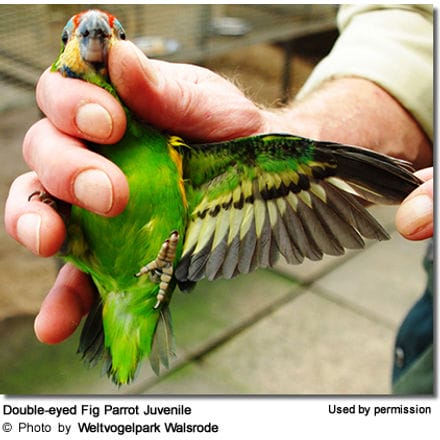

There are eight described subspecies of the Double-Eyed Fig-parrot.
Five subspecies of Double-eyed Fig-Parrot are known from New Guinea and the West Papuan Islands.
- Aru Double-eyed Fig-Parrots (Cyclopsitta diophthalma aruensis)
- Range: southern New Guinea between Mimika and Fly Rivers as well as Aru islands (Maluku province) (first described by Schlegel in 1874)
- Astrolabe Mountain Fig-Parrots (Cyclopsitta diophthalma coccineifrons)
- Range: eastern New Guinea west to Astrolabe Bay and central highlands (first described by Sharpe in 1882)
- Hartert’s Double-eyed Fig-Parrots (Cyclopsitta diophthalma virago)
- Range: Goodenough and Fergusson Islands in D’Entrecasteaux Archipelago, Papua (first described by Hartert in 1895)
- Tagula Double-eyed Fig-Parrots (Cyclopsitta diophthalma inseparabilis)
- Range: Tagula Island in Louisiada Archipelago, Papua New Guinea (first described by Hartert in 1898)
- Cyclopsitta diophthalma festetichi ?


Three subspecies are found in Australia:
- Coxen’s Fig-Parrot (Cyclopsitta diophthalma coxeni)
- Range: Australia – from south-east Queensland and north-east New South Wales, Queensland (first described by Gould in 1867)
- Macleay’s Fig-Parrot or Red-browed Fig-Parrot (Cyclopsitta diophthalma macleayana)
- Range: Australia – from Cooktown to Paluma in north Queensland (first described by Ramsay in 1874)
- Marshall’s Fig-Parrot (Cyclopsitta diophthalma marshalli)
- Range: Australia – from eastern Cape York Peninsula, North Queenlands (first described by Iredale in 1946)
While the Marshall’s and Red-browed Double-eyed Fig Parrots are relatively common in their natural habitat, the Coxen‘s is either extinct or close to extinction. A few unconfirmed sightings of the Coxen’s have been reported, but some experts believe that this fig parrot may indeed be extinct in its natural environment.

Double-eyed Fig-parrots have been declared rare in the Wet Tropics region. These energetic and attractive parrots are infrequently found in aviculture, although their popularity and availability is increasing. Captive double-eyed fig parrots are more common in Europe than in the United States.
Description:
The Double-eyed Fig Parrot is Australia’s smallest parrot averaging 5 1/2 in (13-15 cm) in length. They have short tails, and the head and bill appear disproportionately large.
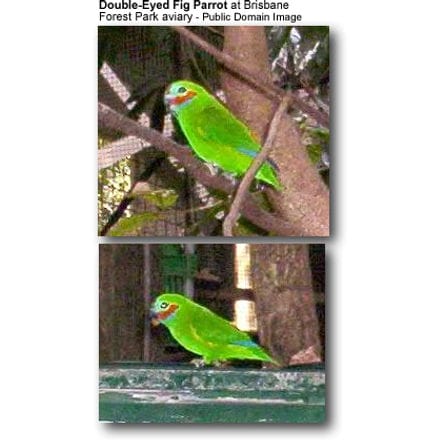
The plumage of these fig-parrots is predominantly green-yellowish with colorful facial patterns consisting of distinctive red and blue markings and a prominent blue forehead in the adult birds. The wings are blue-edged and are particularly noticeable in flight. At rest there are two obvious red spots on the back.
The Double-Eyed Fig-Parrot is sexually dimorphic, with males having a much brighter plumage than females. Both sexes have a red forehead, but the males also have a red cheek patch, while the females’ tends to be yellow.
They can be distinguished from small lorikeets by their short tail and lack of under-wing color.

Breeding:
Unlike many other parrots which generally use existing holes in trees for nests, Double-Eyed Fig-Parrots excavate their own nest cavities by boring a hole into a dead rotten tree to make it a suitable nesting site for raising chicks. Authenticated reports regularly record two eggs as an average clutch size.
For the most part, captive breeding results have been very poor to date. The reason for this appears to be the diet. In recent years, more information on this topic has come to light and breeding successes have significantly increased.
- Housing requirements and captive breeding, as well as pet potential of fig parrots.
- The Diet of Fig Parrots plays a crucial part in ensuring good health and breeding successes of these birds.

Diet:
Fig-parrots generally feed on figs, berries, seeds, nectar, insects and larvae. They also feed on the kernels of many tiny seeds, including those of figs, buttonwood and ironwood. Foraging is done in pairs or in a flock of only a few individuals.
Song / Voice:
These fig-parrots produce short and shrill two or three note zzzt-zzzt or zeet-zeet calls. These calls are usually made in flight, but occasionally they utter them when perched. While feeding, they may also make a variety of softer, chattering noises. For the most part, however, they tend to be quiet once they have finished feeding.
Alternate (Global) Names
Chinese: ????? … Czech: Lorícek žlutoboký, lorí?ek žlutoboký … Danish: Dobbeltøjet Figenpapegøje … Dutch: Dubbeloogvijgpapegaai … Estonian: tulipõsk-viigipapagoi … Finnish: Siniviikunakaija … French: Psittacule double-oeil … German: Rotwangen-Zwergpapagei … Indonesian: Nuriara Mata-ganda … Italian: Pappagallo dei fichi dagli occhiali / quattrocchi … Japanese: Ichijikuinko … Norwegian: Sminkefikenpapegøye … Polish: Figówka zmienana / zmienna … Russian: ?????????? ??????? ????????? … Slovak: figojed žltoboký … Spanish: Lorito de Cuatro Ojos / Dobleojo … Swedish: Dubbelögd fikonpapegoja
Taxonomy:
Genus: Scientific: Cyclopsitta … English: Fig-Parrot … Dutch: Bontkopdwergpapegaaien … German: Buntkopfzwergpapageien … French: Lorillet
Species: Scientific: Cyclopsitta diophthalma diophthalma aka Opopsitta diophthalma diophthalma … English: Double-eyed Fig-Parrot, Two-eyed Fig-Parrot … Dutch: Dubbeloogvijgpapegaai, Maskerdwergpapegaai … German: Maskenzwergpapagei … French: Lorillet à double oeil … CITES I – Protected Species
Sub-Species / Races Including Nominate: diophthalma, festetichi, aruensis, virago, inseparabilis, marshalli, macleayana, coxeni
Distribution: Western New Guinea, Western Papua

Sub-species:
Aru Double-eyed Fig-Parrots:
Distribution: Aru Islands in the province of Maluku in eastern Indonesia, Southern New Guinea
Genus: Scientific: Cyclopsitta … English: Fig-Parrots … Dutch: Bontkopdwergpapegaaien … German: Buntkopfzwergpapageien … French: Lorillet
Species: Scientific: Cyclopsitta diophthalma aruensis aka Opopsitta diophthalma aruensis … English: Aru Double-eyed Fig-Parrot … Species Dutch: Aru Maskerdwergpapegaai … German: Aru Maskenzwergpapagei … French: Lorillet Aru à double oeil … CITES I – Protected
Astrolabe Mountain Fig-Parrots:
Distribution: Eastern New Guinea
Genus: Scientific: Cyclopsitta … English: Fig-Parrots … Dutch: Bontkopdwergpapegaaien … German: Buntkopfzwergpapageien … French: Lorillet
Species: Scientific: Cyclopsitta diophthalma coccineifrons aka Opopsitta diophthalma coccineifrons … English: Astrolabe Mountain Fig-Parrot … Species Dutch: Astrolabe Maskerdwergpapegaai … German: Astrolabe Maskenzwergpapagei … French: Lorillet à front ecarlate double oeil … CITES I – Protected
Coxens Double-eye Fig Parrots (Cyclopsitta diophthalma coxeni)

Hartert’s Double-eyed Fig-Parrots:
Distribution: Goodenough and Fergusson Islands in the D’Entrecasteaux Archipelago, Papua
Genus: Scientific: Cyclopsitta … English: Fig-Parrot … Dutch: Bontkopdwergpapegaaien … German: Buntkopfzwergpapageien … French: Lorillet
Species: Scientific: Cyclopsitta diophthalma virago aka Opopsitta diophthalma virago … English: Hartert’s Double-eyed Fig-Parrot … Dutch: Harterts Maskerdwergpapegaai … German: Harterts Maskenzwergpapagei … French: Lorillet d’entre casteaux à double oeil … CITES I – Protected Species
Marshall’s Fig-Parrots:
Description: The male has some pale red in the face and a soft purple color under the ear.

Distribution: Cape York Peninsula, North Queensland in Australia
FREE Training to Stop Your Bird's Biting
Get FREE access to Beak School – the only system designed to train your bird. Stop behavioral problems like biting, screaming, feather plucking.
Get the Free TrainingGenus: Scientific: Cyclopsitta … English: Fig-Parrot … Dutch: Bontkopdwergpapegaaien … German: Buntkopfzwergpapageien … French: Lorillet
Species: Scientific: Cyclopsitta diophthalma marshalli aka Opopsitta diophthalma marshalli … English: Marshall’s Fig-Parrot … Dutch: Marshall’s Maskerdwergpapegaai … German: Marshalls Maskenzwergpapagei … French: Lorillet à double oeil de Marshall … CITES I – Protected Species
Red-browned Fig-Parrots aka Macleay’s Fig-Parrot (Cyclopsitta diophthalma macleayana aka Opopsitta diophthalma macleayana
Tagula Double-eyed Fig-Parrots:
Distribution: Tagula Islands in the Louisiade Archipelago, Papua
Genus: Scientific: Cyclopsitta … English: Fig-Parrot … Dutch: Bontkopdwergpapegaaien … German: Buntkopfzwergpapageien … French: Lorillet
Species: Scientific: Cyclopsitta diophthalma inseparabilis aka Opopsitta diophthalma inseparabilis … English: Tagula Double-eyed Fig-Parrot … Dutch: Tagula Maskerdwergpapegaai … German: Tagula Maskenzwergpapagei … French: Lorillet Tagula à double oeil … CITES I – Protected Species
Double-eyed Fig Parrots aka Blue-faced Fig Parrots
 Keeping and Breeding Fig Parrots
Photos of Different Fig Parrot Species for Identification
The Coxen’s Fig Parrot or Coxen’s Double-eyed Fig-parrot (Cyclopsitta diophthalma coxeniis) is a sub-species of the Double-eyed Fig Parrot. Its natural range is limited – from the Mary River (Gympie) in Queensland south to the Richmond River in New South Wales and west to the Bunya Mountains in Australia. Others state that the distribution reaches Maryborough in the north and the Macleay River in the south.
Its preferred habitat includes the lowland dry and subtropical rainforest, especially in alluvial areas in which fruiting fig trees can be found. Some populations have been reported visiting isolated fruiting trees in gardens and cultivated farmlands.
Conservation Efforts
Many experts agree that the Coxen’s Fig Parrot may in fact be extinct in its natural habitat – although unconfirmed sightings have been reported. As proof of its actual extinction in its native environment is not available yet, this fig parrot is officially reported to be one of the most critically endangered birds in Australia. Some speculate that fewer than 100 of them are remaining in the wild; others state that up to 200 may still be found in their range.
Recovery efforts to save the Coxen’s Fig-Parrot from certain extinction are underway, one of which is lead by Ian Günter, Senior Conservation Officer with Queensland Parks and Wildlife Service and Queensland Co-ordinator of the Coxen’s Fig Parrot Recovery Program (please refer to the photo to the right). The conservation of the Coxen’s Fig Parrot is directed towards preserving potential habitat and determining the extent and distribution of the remaining populations.
Details pertaining captive populations are not available. The importance of integrating any captive specimen into a well-managed breeding program is well understood.
 Description:
FREE Training to Stop Your Bird's Biting
Get FREE access to Beak School – the only system designed to train your bird. Stop behavioral problems like biting, screaming, feather plucking.
Get the Free TrainingCoxen’s Fig Parrots are small parrots with a stout build – averaging 15cm in length, including their short tails. The head has distinctive red and blue markings with a prominent blue forehead in adults.
These predominantly green parrots have disproportionately large heads and bills. The plumage is a rich green above and a yellowish green below. The sides of its breast are yellow. The flight feathers are a deep blue and dark grey. When perching, two obvious red spots on the back can be seen, representing the inner edges of the flight feathers. (Refer to the photo to the right). The bill is pale grey at the base and blackish towards the tip.
The male has a blue forehead with scattered red feathers surrounding this and on the lores (the regions between the eyes and bill on the side of a bird’s head). His cheeks are orange-red, bordered below by a band of mauve-blue. The female is similar, except she has a smaller blue patch on the forehead, and fewer or no red on the forehead and lores. Her orange-red cheek patch is duller and less extensive than that of the male.
They can be distinguished from small lorikeets by their short tail and lack of underwing color.

Breeding:
Little is known about the reproductive habits of this species. It is believed that they excavate nest chambers in dead or decaying tree limbs or trunks in, or close to, the rainforest. Each clutch usually consists of two eggs. Breeding season in their natural habitat is thought to commence in August and may go on until December or January.
Diet:
The bird prefers feeding on the fruits of fig trees, but also feeds on other fruiting rainforest species. It can be detected by discarded pieces of fig flesh falling from its feeding tree onto the ground.
FREE Training to Stop Your Bird's Biting
Get FREE access to Beak School – the only system designed to train your bird. Stop behavioral problems like biting, screaming, feather plucking.
Get the Free TrainingCalls:
Its flight call is a short, clipped two note call described as a high-pitched, conspicuous ‘zeet-zeet’ that is readily detectable. When foraging, it may utter soft chattering calls – otherwise it is silent.

Taxonomy:
Genus: Scientific: Cyclopsitta … English: Fig-Parrot … Dutch: Bontkopdwergpapegaaien … German: Buntkopfzwergpapageien … French: Lorillet
Species: Scientific: Cyclopsitta diophthalma coxeni aka Opopsitta diophthalma coxeni … English: Coxen’s Double-eyed Fig-Parrot … Dutch: Coxens Dubbeloogvijgpapegaai, Roodwangdwergpapegaai … German: Blauwangen Maskenzwergpapagei … French: Lorillet à double oeil de Coxen … CITES I – Protected Species
Distribution: Coastal Regions Southern Queensland, Northern New South Wales in Australia / Extinct?
Species Research by Sibylle Johnson
Please Note: The articles or images on this page are the sole property of the authors or photographers. Please contact them directly with respect to any copyright or licensing questions. Thank you.